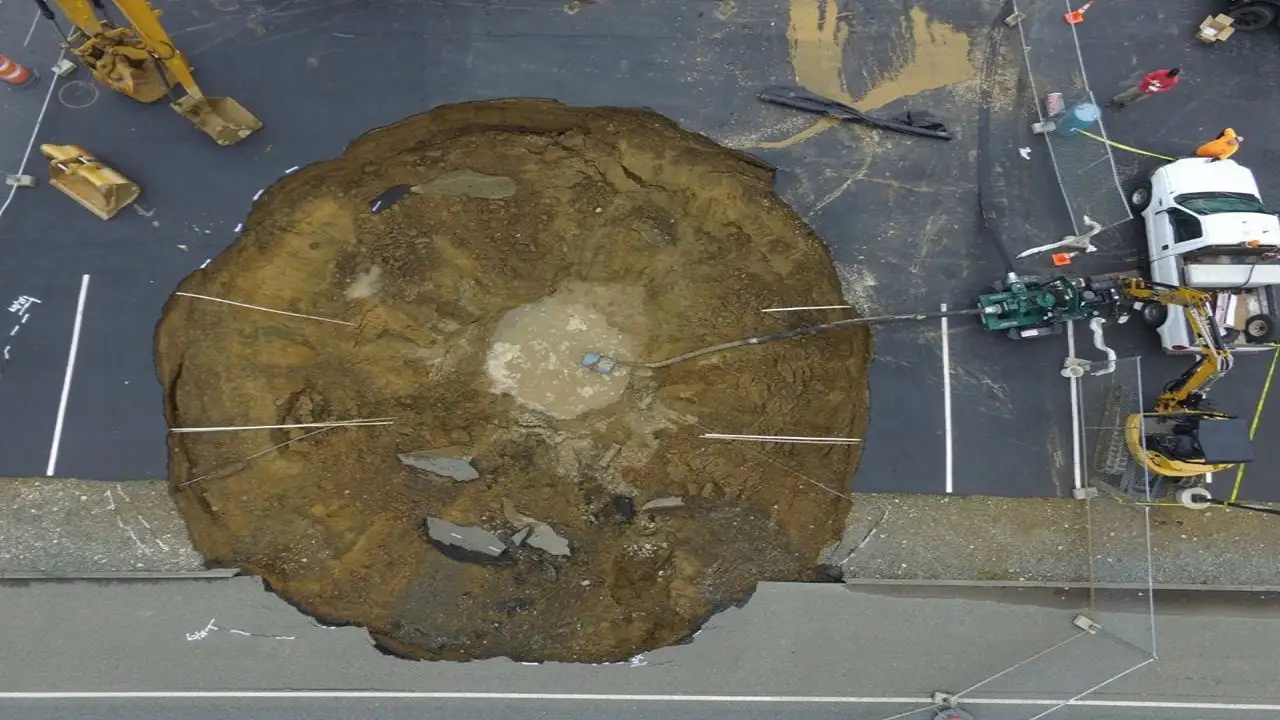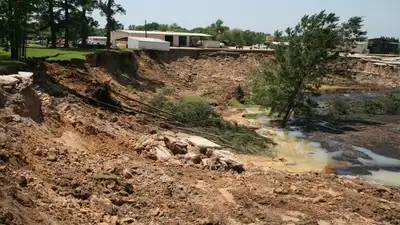
An area affected by the massive sinkhole in Daisetta, Texas. Credits – usgc.gov
The town’s obscurity came to an abrupt end in the spring of 2008 when the ground beneath it collapsed, transforming a small pit into one of the biggest sinkholes ever discovered in the US. On that Wednesday morning, residents saw a little sinkhole spring up along Farm to Market Road 770 on the edge of town. But within hours the hole was expanding at an alarming rate and by the next day was a crater some 900 feet big and 260 feet deep.
Witnesses said the sound was like a freight train going by. Located in Liberty County, Texas, about sixty miles northeast of Houston, Daisetta is a sleepy town with about a thousand residents. It has mostly been recognised, if at all, for perched above the Hull salt dome, a massive subterranean rock salt pillar that has attracted brine and oil drillers to the region since the early 1900s. In just one day, what started out as a hole that was only twenty feet across grew into a churning crater that was hundreds of feet wide and deep enough to swallow telephone poles, cars, oil tanks and other equipment. At first it seemed inconspicuous, little bigger than a swimming pool, and few people paid it much attention. Local residents watched as the ground crumbled and swallowed up oil storage tanks, barrels, tyres, power poles and several vehicles. Emergency officials halted the nearby stretch of highway, evacuated buildings around the location and eventually had to alert curious sightseers who wanted a closer look at the widening pit. Around two days after the collapse, researchers from the University of Texas at Dallas quickly deployed a mobile laser scanning team to the site in the hope of capturing the changing shape of the crater before it stabilised. More than a decade later, parts of the ground around the original crater crumbled again, a reminder that a salt dome filled with old wells rarely stops moving in one go and that a community founded on one has to live with that uncertainty forever. It is still a useful example for geologists to analyse how activities in an oilfield can speed up a natural process that might otherwise have taken centuries to reach the surface.
Today, the crater is partially filled with water and has become an unlikely local monument, visible from the highway, a lasting feature that still draws occasional curious visitors even as Daisetta has largely returned to normal.