
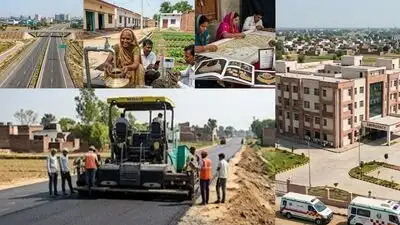
Budaun has seen significant development beyond agriculture over nine years (AI image)
As per 2011 census, Budaun had a population of about 31.29 lakh, of which nearly 25.35 lakh lived in rural areas. The district covers more than 4,234 sq km and has 15 development blocks and 1,478 populated villages. A major feature of the transformation since 2017 has been the effort to improve basic infrastructure and last-mile connectivity. The official Uttar Pradesh Jal Jeevan Mission records, for example, show water-supply schemes such as Kunar, Malikpur and Dadmai being taken up and dedicated in 2026. Healthcare has expanded through the medical college; rural life is changing through household tap-water schemes; agriculture is being supported through modern inputs and watershed interventions; traditional artisans are receiving a platform through ODOP; and urban development is acquiring a long-term framework through the Master Plan 2031.
Because improved connectivity can reduce the traditional disadvantage faced by predominantly rural districts, the emerging network of expressways and highways is particularly significant. The district’s progress under the rural drinking-water programme therefore forms an important component of its broader social transformation. Because rapid urbanisation requires planned expansion rather than unregulated growth, the Master Plan is significant. A district preparing for its next phase of growth The transformation of Budaun should therefore be seen as a multi-dimensional process rather than a single mega-project.
If the gains in infrastructure, water supply, healthcare and artisan-based enterprise are matched by stronger agro-processing, MSME investment, skill development and market connectivity in the coming years, Budaun can increasingly evolve from an agriculture-dominated district into a more diversified economic and service hub of western Uttar Pradesh. (District Transformation) Stay updated with the latest Bareilly news. Badaun: moving in sync with growing western UP economy Over the last nine years, Budaun has been witnessing a gradual but significant transformation, with development moving beyond the traditional agrarian economy towards better connectivity, healthcare, drinking-water infrastructure, urban planning, rural livelihoods and promotion of traditional industries. The change is particularly important for a district that remains overwhelmingly rural. Better roads and improved links with neighbouring districts have gradually strengthened Budaun’s integration with the wider Rohilkhand and western Uttar Pradesh economy. The state’s broader infrastructure push has also benefited districts such as Budaun by improving access to markets, educational institutions, healthcare facilities and employment centres. Healthcare emerges as a major pillar One of the most visible changes has been in medical education and healthcare infrastructure. The district administration lists the Government Medical College and Hospital among its principal educational and medical institutions. This is important not merely as a healthcare intervention but also as an economic one. A medical college creates demand for trained professionals, nursing and paramedical services, pharmacies, diagnostics, accommodation, transport and other ancillary activities. In this sense, expansion of medical infrastructure can gradually transform the district into a regional service centre. The district’s healthcare ecosystem is also being strengthened through recruitment and expansion of public health services. The district administration’s records show continuing recruitment for MBBS medical officers, AYUSH doctors and other health-related positions in recent years. Har Ghar Jal and the transformation of rural life For a predominantly rural district, household tap-water supply represents one of the most consequential changes . Under the Jal Jeevan Mission, water-supply schemes have been implemented across Budaun’s villages. The significance goes beyond the installation of pipelines. Reliable household water reduces the burden of fetching water, particularly for women, improves household convenience and creates better conditions for sanitation and public health. Agriculture remains the economic backbone—but is becoming more technology driven Agriculture continues to be central to Budaun’s economy. The district administration currently provides farmers assistance through subsidies for storage bins, zinc sulphate, micronutrients, agricultural equipment and other inputs. Proper zoning, roads, commercial areas, housing, public facilities and infrastructure planning can help Budaun accommodate future population and economic growth while protecting essential urban services. From welfare delivery to digitally monitored governance The transformation has also been institutional. Increasing use of digital platforms, online applications and district-level monitoring has made government delivery more transparent and accessible. The district administration’s current digital portal provides online access to information relating to schemes, recruitment, documents, tenders, medical establishments and other public services. This digital transition complements broader state-level reforms in direct benefit transfer, Aadhaar-enabled services and online monitoring, reducing dependence on intermediaries and bringing government programmes closer to beneficiaries. The district still has considerable challenges. Its large rural population, dependence on agriculture, limited industrial base and need for stronger higher-education and employment opportunities mean that the transformation is an ongoing process. But the direction has changed. The development strategy is increasingly centred on connectivity, basic amenities, human capital, rural incomes, traditional enterprise and planned urbanisation. Budaun’s story over the past nine years is consequently one of laying the foundations for a more diversified local economy. Download the TOI App.
Budaun now has a Government Medical College and Hospital at Naushera on the Ujhani Road, giving the district a substantially stronger institutional healthcare base than was available earlier.
Government data for Budaun records watershed projects covering 10,000 hectares in the 2021-22 project cycle, with the baseline area overwhelmingly under cereal cultivation but also including pulses, oilseeds and horticulture. Urban Budaun gets a planned growth framework Another important development is the approval of the Budaun Master Plan 2031 in 2025. The emphasis is increasingly shifting from simply increasing acreage to improving productivity, reducing input costs and diversifying farm incomes . Watershed and soil-moisture conservation programmes are another part of this transition. This creates an opportunity for Budaun to move towards higher-value agriculture, food processing, horticulture and allied activities. Better roads, cold-storage capacity and market linkages can further help farmers obtain better returns. Zari-Zardozi gets a new economic identity Budaun’s transformation is not confined to infrastructure. The district’s traditional Zari-Zardozi industry has received institutional recognition through the One District One Product programme. The Uttar Pradesh ODOP documentation identifies Budaun’s Zari-Zardozi as its signature product and notes that the craft is prominent in Budaun, Bisauli and Dataganj areas. The importance of ODOP lies in converting traditional skills into sustainable enterprises by improving access to finance, technology, training, branding, packaging and markets. The official ODOP portal also maintains a dedicated project report for Budaun’s Zari-Zardozi work units. For artisans, this represents a shift from an informal cottage activity towards a more organised livelihood ecosystem. Greater market access, e-commerce and exhibitions can help connect Budaun’s artisans with buyers outside the district and state. The district administration lists the approved Master Plan among its major recent administrative documents.