
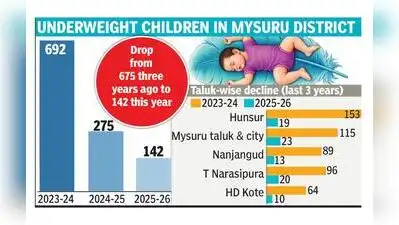
Mysuru: The number of underweight children in Mysuru district dropped to 142 this year from 675 three years ago. The highest number of underweight children was reported from tribal hamlets of forest fringe villages.
Mysuru district registered 692 underweight children in 2023-24, according to year-wise reports. The number declined to 275 in 2024-25 and further to 142 in 2025-26. Taluk-wise reports over the last three years showed the number of underweight children declining to 19 from 153 in Hunsur taluk, to 23 from 115 in Mysuru taluk and city, to 13 from 89 in Nanjangud taluk, and to 20 from 96 in T Narasipura taluk. In HD Kote taluk, the number declined to 10 from 64. Currently, Mysuru city has 23 underweight children, Nanjangud 23, T Narasipura 20, Hunsur 19, KR Nagar 13, HD Kote 10, Mysuru rural 10 and Periyapatna 10. The department has reserved 20 beds for such children at Cheluvamba Centre and five beds at the district hospital. Speaking to TOI, deputy director of women and children welfare Nagaraju said the department receives about Rs 76 crore every year from the Union govt for nutrition and maternal care to ensure nutritious food supplements for children and pregnant mothers of anganwadi children throughout the year, including special fund support for nutrition care of underweight children under various state and Union govt schemes. Underweight children in Mysuru district Year No of children 2023-24 692 2024-25 275 2025-26 142 Drop from 675 three years ago to 142 this year Taluk-wise decline (last 3 years) Taluk 2023-24 2025-26 Hunsur 153 19 Mysuru taluk & city 115 23 Nanjangud 89 13 T Narasipura 96 20 HD Kote 64 10 Current underweight children tally Mysuru city: 23 Nanjangud: 23 T Narasipura: 20 Hunsur: 19 K R Nagar: 13 H D Kote: 10 Mysuru rural: 10 Periyapatna: 10 Source: Women and child welfare department You Can Also Check: Gold Rate in Mysuru | Silver Rate in Mysuru | Bank Holidays in Mysuru | Public Holidays in Mysuru Stay updated with the latest Mysuru news.
They said protection of children from childhood diseases, preventive measures against sudden weight loss, access to safe drinking water, and improved antenatal care and maternal and child nutrition care programmes also contributed to the reduction. “The effective implementation of govt schemes, nutrition care, maternal awareness and access to safe drinking water, among other factors, contributed to the decline in underweight children in the district,” he said. “As underweight is associated with an underdeveloped brain and long-lasting harmful effects among children, including diminished mental ability, learning capacity, poor school performance in childhood, and increased nutrition-related chronic disease, govt must give special attention to protect and rehabilitate such children,” said Sudha Doreswamy, retired govt medical officer, to TOI.
Children between six months and six years old suffering from low weight stemming from poor nutrition intake and affected by frequent childhood infections are considered underweight and low-weight children. Experts attributed the decline to improved maternal care, stronger health infrastructure, greater awareness of breastfeeding for the first six months, distribution of nutrition kits including milk powder, eggs, nutrient-rich chakki and laddu, and the provision of vitamin A supplements and iron and zinc tablets. The effective implementation of govt schemes such as Poshan Abhiyan, the midday meals scheme, Integrated Child Development Schemes and other programmes also contributed significantly to reducing stunting and underweight among children. Department of women and child welfare, entrusted with the responsibility of caring for underweight children, has currently rehabilitated seven children at the Nutritional Rehabilitation Centre at Cheluvamba Centre. Download the TOI App.