(Representative image) New housing supply in Bengaluru is increasing, but it is tilting towards higher-priced homes
New supply is growing, but the city’s housing market is steadily tilting towards higher-ticket homes as land & construction costs continue to rise.
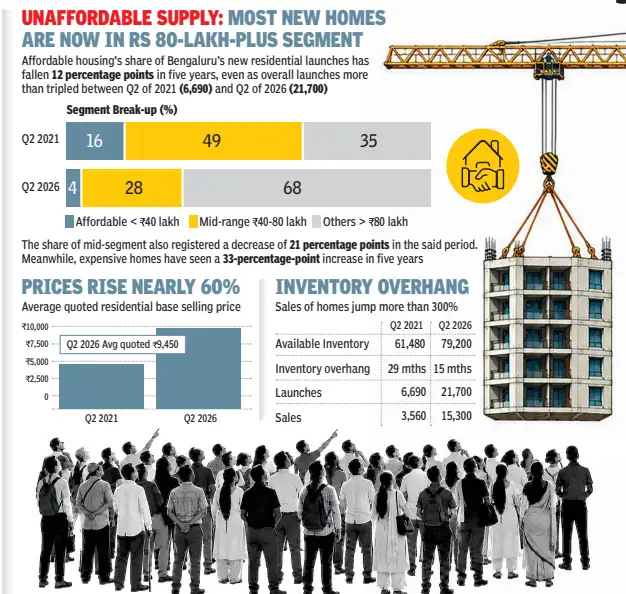
The city saw thousands of residential units launched in the first half of 2026, analysis of data from multiple consultancy firms reveals. As per Cushman & Wakefield, high-end and luxury homes accounted for 68% of launches in the first quarter (Q1), while affordable housing made up just 1%. In the second quarter (Q2), there were no affordable launches, with high-end and luxury homes accounting for 58% and the mid-segment for 42%. Unaffortable suppy Anarock Research’s numbers show a similar trend, though it uses a lower threshold for affordable housing, defining it as homes below Rs 40 lakh. By that measure, affordable homes accounted for 5% of new supply in Q1 and 4% in Q2. The largest share of Q2 launches, 43%, was in the Rs 80 lakh-Rs 1.5 crore bracket. Cushman & Wakefield recorded a 6-7% year-on-year rise in Bengaluru’s capital values in Q2, while Anarock’s average quoted rate reached about Rs 9,450/sqft. Anarock estimates land values in Bengaluru rose 60-120% between 2021 and H1 2026. What’s driving up construction cost and how it impacts Across India’s top seven cities including Bengaluru, Anarock Research data shows that the average cost of constructing a standard-plus residential project rose 34%, from Rs 2,681/sqft in 2021 to Rs 3,604/sqft in 2025. Over the same period, average residential capital values rose 59%, from Rs 5,826 to Rs 9,260/sqft. Anarock says land values across the top seven cities rose by roughly 50-120% between 2021 and H1 2026, with Bengaluru recording a 60-120% increase. Anarock estimates Middle East-related disruptions have added another 8-10% to construction costs, with steel and fuel-linked logistics among the sharpest movers. Steel prices are estimated to be about 20% higher, while fuel and site logistics have risen 15-20%. Labour remains the largest single cost component, accounting for roughly 25-30% of project costs, although its increase has been more moderate at 5-6%. Cushman & Wakefield reports that citywide rents rose 6–7% year-on-year in Q2 2026, with the increase driven by demand for rental apartments around prime office corridors.
The problem, therefore, is not simply a shortage of homes, but a mismatch between what is being built and what many buyers can afford. The sharpest increases have been in established, high-demand corridors where infrastructure improvements can push up land values even before a project is launched. You Can Also Check: Gold Rate in Bengaluru | Silver Rate in Bengaluru | Bank Holidays in Bengaluru | Public Holidays in Bengaluru | Bengaluru AQI | Weather in Bengaluru | Petrol Price in Bengaluru | Diesel Price in Bengaluru | CNG Price in Bengaluru | LPG Price in Bengaluru Stay updated with the latest Bengaluru news.
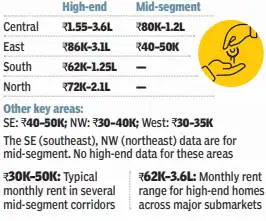
Bengaluru is building plenty of homes. What it is building more of are homes at the price points that a large section of buyers can’t afford. But the composition of that supply tells a different story. The definitions differ, but the direction is clear: new housing supply is moving up the price ladder. Prices are rising too. At the same time, the cost of creating housing has risen sharply. In established and infrastructure-led corridors, rising land costs can push up project costs even before construction begins. That leaves developers with less room to offer genuinely affordable homes while maintaining viable margins. Construction costs, however, do not include land — a critical distinction in understanding the final price of a home. The pressure on construction costs has also intensified. Data of the area Renting: Avg rates show this isn’t cheaper either As buying a home moves further out of reach, even the rental option is becoming costlier in Bengaluru’s job-rich corridors. Download the TOI App.