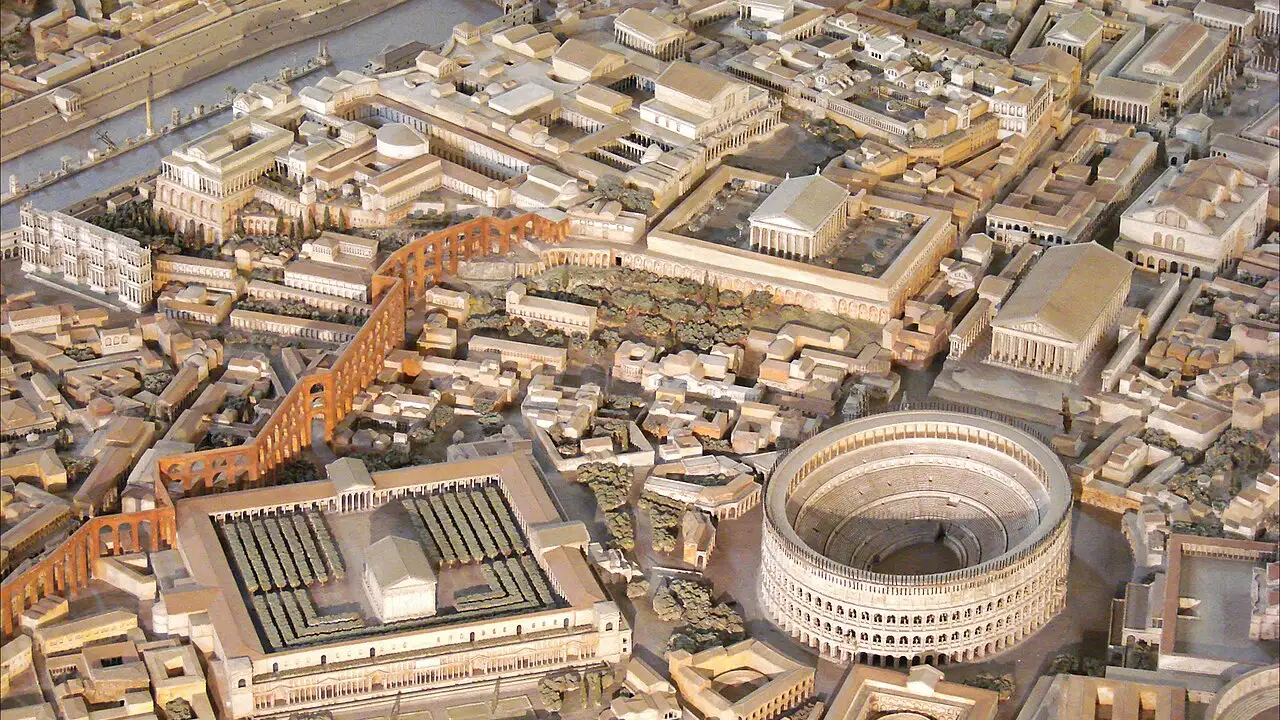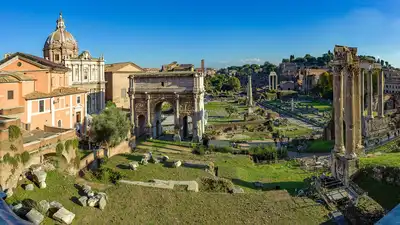
The Roman Forum contains the ruins of the buildings that represented the political, legal, religious and economic centre of ancient Rome, constituting the “nerve centre” of all Roman civilisation (Image: Wolfgang Moroder)
Researchers have created the most detailed digital model yet of the Roman road network, mapping 299,171.31 kilometres, or roughly 186,000 miles, of roads across the empire’s full territorial extent. The research team mapped the road network of the Roman Empire at its territorial peak in 117 CE, when it stretched across almost 5,500,000 square kilometres around the Mediterranean. In total, they traced 299,171 kilometres of roads across a study area of just over 5.27 million square kilometres, working out to a density of about 57 metres of road for every square kilometre of land. Of all that road, roughly 91% (271,000 km) sat on gentle enough slopes for carts and wagons to actually use. Not every stretch was mapped with the same certainty, only about 3% of the roads are based on firm archaeological evidence, while the rest is either a well-informed guess (7%) or a reconstruction based on patterns and context rather than direct traces on the ground (90%). The study found Roman roads had a mean sinuosity of 1.048, close to fully straight but consistently less so than modern roads, which measured 1.024 on average. Model of Imperial Rome at the Museum of Roman Civilisation in Rome (Image: Jean-Pierre Dalbéra) Researchers ranked every city by how central it was to getting around the empire on foot or by cart, and found something surprising, 24 of the 45 provincial capitals landed among the best-connected places in the whole network, showing these cities weren’t picked at random, they sat where the roads naturally converged.
But here’s the twist, despite the old saying that “all roads lead to Rome,” Rome wasn’t actually the best-connected city by land. Here’s what the empire-wide analysis found. Roads tended to be straightest in lowland regions such as Western Europe, the Pannonian basin, North Africa and central Anatolia, where topography allowed for more direct routes. Main roads, likely representing public and military routes, showed slightly lower sinuosity than secondary roads, closer to modern road standards. The researchers concluded that while Roman engineers consistently favoured straight alignments where terrain permitted, the long-held assumption that Roman roads were uniformly rectilinear across the empire doesn’t hold up. Byzantium came out especially well placed, since it was the bridge point where Europe’s roads met Asia’s, crossing over near the Bosphorus and the Dardanelles. Places like Antioch, Ankara, Byzantium and Corinth all beat it. Rome’s real strength lay elsewhere, in how well it was connected by sea and river, not by road. Roman roads and modern roads still tend to run in roughly the same places, the study found. But some regions have grown their roads a lot since Roman times, while others haven’t. Northern Italy, the area around the Rhine and Meuse rivers, and Britain have all seen the sharpest jumps in road density since Roman times, especially around cities like Paris, Marseille and Madrid. Meanwhile, Greece, Turkey, Tunisia and Algeria tell the opposite story. So it’s not that Rome built more roads where things are busy now; it’s that some places kept building long after Rome, and others simply didn’t. Catch the latest World News and Live updates. Download the TOI app.
Published in Nature Communications, the study ‘ Network science reveals the structure and lasting impact of the Roman road system ’ used network science to test long-held assumptions about Roman roads, whether they were truly straight, how central cities like Rome actually were, and how closely Roman infrastructure still lines up with modern roads today. Some of today’s biggest cities, including Birmingham, Brussels, Paris and Madrid, grew from small Roman-era settlements into major metropolitan centres, which explains a lot of that growth. These were some of the busiest, most road-connected parts of the Roman Empire, but today they have comparatively few roads by comparison.