
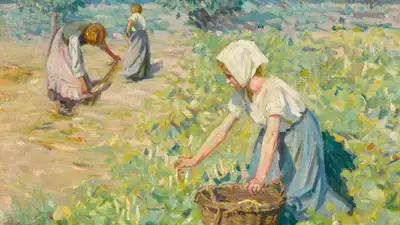
Helen Galloway McNicoll, The Bean Harvest, estimated £150,000-250,000. Sold for £174,000
The authenticated painting was later offered at Sotheby’s in London, where Canadian philanthropist and art collector Pierre Lassonde bought it for £174,000. In a statement released by the Art Gallery of Hamilton, Shelley Falconer, the institution’s President and Chief Executive Officer, spoke about the importance of bringing the painting back to Canada.
Lassonde, who had previously called the painting “magnificent”, loaned it to public institutions so that people could see it again for the first time in 110 years. Canada, the painting was placed on central display as part of the exhibition Helen McNicoll: An Impressionist Journey, according to a media release from the Art Gallery of Hamilton in Ontario. “We are extremely honoured to feature The Bean Harvest as part of Helen McNicoll: An Impressionist Journey,” Falconer said. “This exhibition is a truly inspiring tribute to one of Canada’s most important Impressionist painters, and we invite everyone to experience her remarkable work in person.”
The exhibition was organized by the Musée national des beaux-arts du Québec and adapted by the Art Gallery of Hamilton.
An English artist and part-time art dealer who bought a wrongly labelled oil painting for £2,090 at a regional UK auction made a life-changing discovery when experts confirmed that the painting was a long-lost Impressionist masterpiece. It was eventually sold at auction for £174,000 to Canadian collector Pierre Lassonde, bringing the painting back into public view after more than a century. Technical tests compared Taylor’s painting with a known McNicoll work, The Apple Gatherer, painted around 1911. It had been shown five times in Canada between 1912 and 1913 before disappearing from public records. After the painting was authenticated, Mould estimated that The Bean Harvest could sell for £300,000 on the open market.
Historical research for the programme revealed that McNicoll had painted a work called The Bean Harvest.
The artwork had originally been listed only as “in the style of” Canadian Impressionist Helen McNicoll and was later valued by specialists at £300,000. The plaque misspelled the artist’s name as “McNicol” and said the painting was made in 1958, more than 40 years after McNicoll died in 1915. He thought the farming scene looked as if it had been painted by “someone who really knows what they’re doing”, according to a report by Artnet. During the Fake or Fortune? programme, Bruce praised the painting for its “light and movement” and called McNicoll “a pioneer”.
David Taylor bought the painting at an auction where it was kept in a cheap plastic 1960s frame. It also had a brass-coloured plaque with the title Women of the Fields. Despite these mistakes, Taylor noticed the high quality of the brushwork. However, art records did not list a work called Women of the Fields among her known paintings. Unsure about the painting’s history, Taylor contacted the team behind the BBC television programme Fake or Fortune?, led by art dealer Philip Mould and broadcaster Fiona Bruce. The programme began a detailed scientific and historical investigation to find out whether the painting was genuine. Experts found that the same pigments had been applied in the same ways to the figures’ faces and the foliage in the background of both paintings. Laboratory tests also found Red Lake pigment made from natural organic materials. Under ultraviolet light, the pigment produced a pink glow in matching patterns on both paintings. This showed that the artist had used the same types of materials and pigments. Provenance research carried out during the BBC investigation showed that the painting had later entered the private collection of the Pine-Coffin family in Britain. Norman Pine-Coffin, a British painter, had exhibited at London’s Royal Academy around the same time as McNicoll. This suggested that the two artists may have known each other and helped explain how the painting moved from Canada to Britain.