
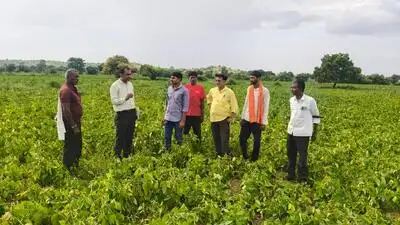
Field demonstrations carried out under the National Innovations in Climate Resilient Agriculture (NICRA) programme
Chhatrapati Sambhajinagar: Farm ponds, protective irrigation and moisture-conservation measures delivered yield gains of up to 48% in three Parbhani villages — offering a field-tested approach to managing dry spells in rainfed farming. The field demonstrations have been carried out since 2024 under the National Innovations in Climate Resilient Agriculture (NICRA) programme at Babhulgaon, Ujalamba and Sonna villages by Vasantrao Naik Marathwada Agricultural University, Parbhani. The trials showed a 32% to 48% yield advantage from farm-pond water and protective irrigation during terminal drought, while the BBF system recorded up to 40 % yield gain.
University vice-chancellor Indra Mani said the results assume significance against recurring rainfall variability in Marathwada with the region staring at severe drought. “The documented results provide a strong basis for scaling up integrated NICRA climate-resilient interventions across rainfed areas of Marathwada, with systematic monitoring of crop yield, water-use efficiency, farm economics and, wherever possible, pre- and post-monsoon groundwater levels to quantify the long-term water-security impact,” he said. NICRA combined advanced preparedness with real-time contingency measures, including contour farming, conservation furrows, broad-bed-and-furrow technology, mulching, residue management, rainwater harvesting and farm ponds. During dry spells, farmers used protective irrigation, timely weeding, foliar application of potassium nitrate and other crop-specific measures. Trials also indicated enhanced groundwater recharge potential, though village-wise measured recharge data was unavailable.