
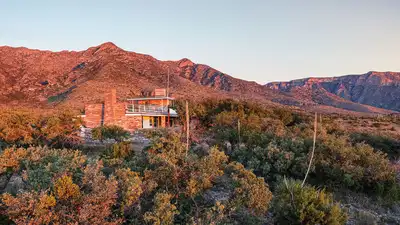
In 1921, Texas oil geologist Wallace Pratt travelled into a remote, wind-swept oasis in West Texas and fell in love with its tall limestone walls and bright autumn colours. Thirty-eight years later, his long love for McKittrick Canyon helped change the future of Texas conservation. Pratt gave his home and thousands of acres to the federal government, creating the core of what would become Guadalupe Mountains National Park.
By 1931, Pratt and his wife, Pearl Stuckey, had built a small stone cabin inside McKittrick Canyon. The cabin was designed by architect John Staubs and built during the winter of 1931 to 1932. After Pearl died in 1940, Pratt married Iris Calderhead in 1941. Planning began in 1941, construction started in 1942, and the house was completed by 1943. Pratt, had been named after him in 1937.
Because of preservation needs, it is generally closed to the public. Because its exposed rock layers reveal the structure of the ancient Permian reef, mcKittrick Canyon remains an important place for geologists.
The unusual home became known as “Ship on the Desert” because its long shape and modern design made it look like an oil tanker. Made from local stone, it became the Pratt family’s summer home. The cabin was beautiful but its location had problems. The narrow canyon could be hit by strong floods and bad weather. Pratt began looking for a safer site on higher ground. Calderhead was a prominent supporter of the women’s suffrage movement and had been involved with the National Woman’s Party. Soon after their marriage, the couple began planning a second home outside the canyon. They chose a site southeast of the canyon mouth. The New York City architecture firm Milliken & Bevin designed the house. It used local limestone and large areas of glass to connect the house with the surrounding landscape. The National Park Service describes it as an early example of modernist architecture in the remote West Texas region. The house also reflected the lives of both owners. Its ship-like design was a tribute to Pratt’s career in the oil industry. An oil tanker, the Wallace E. A bright purple front door was a nod to Iris Pratt’s work for women’s suffrage, since purple was one of the colours linked to the suffrage movement and the National Woman’s Party. The buildings Pratt created remain important historic parts of the national park. Pratt Cabin, located at the meeting point of the North and South branches of McKittrick Canyon, is now an interpretive site and rest stop for hikers. The National Park Service uses the cabin to tell the story of the Pratt family and their years in the canyon. Ship on the Desert is also preserved by the National Park Service. The house is listed on the National Register of Historic Places and is recognised as an early example of modernism in West Texas. The house still shows the personal touches that connected Pratt’s life to the building. Its long form recalls the oil tanker named for him, while its purple front door reflects Iris Pratt’s connection to the women’s suffrage movement. It is also a popular destination for visitors, especially in autumn, when the canyon’s trees add bright colour to the surrounding desert landscape.