
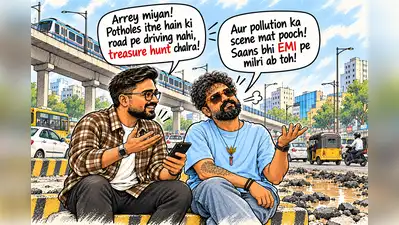
Hyderabad: Not too long ago, Hyderabad’s social media feed was ruled by food reels, café recommendations and endless debates over what and where to eat next. Today, a different category of videos is cutting through the biryani-and-brunch scroll.
A new crop of creators is using Dakhni — the city’s most familiar and unfiltered dialect — to talk about potholes, disappearing heritage, drainage woes, pollution and consumerism. Turns out, the language that has always been good at punchlines is pretty good at making a point too.
For Mohd Abdul Rahman, 24, who goes by @rizwan.xy, the journey began in one of Hyderabad’s newsrooms. The same philosophy drives Mohammed Nadeem Arqum, 25, better known as @zonar_x.
“I’m basically giving a commentary on things that I observe in my day-to-day life,” says Atul Rastogi, 41, whose Instagram page @beware_of_hyderabad has gained attention for its sharp, witty takes on the city. His early reels joked about Hyderabad’s relaxed sense of time and the gutka stains that make some streets look like residents are “walking on a red carpet”. We have our own voice, our own observations and our own curiosity,” he says. “There were a few topics that hit me differently, and I didn’t want to do them the conventional way,” he says. The issues remain serious, but they arrive without the usual moral instruction or the “we need to talk about this” vibe. It’s relatable,” Abdul says. The audience connects the dots themselves,” he says. “I realised there were a lot of problems in our daily lives that nobody was talking about,” he says. But Arqum’s process is not exactly just “see problem, shoot reel, post”. Every reel, he says, starts with research. I wanted to make world-class production with the soul of the Hyderabadi language,” Arqum says. Everybody from Hyderabad understands that tongue,” says Rastogi. “The language flourished under the Qutb Shahi rulers of Golconda and Adil Shahis of Bijapur, who encouraged literary and self-expression in Dakhni,” she says. Instead, it became a language of culture, poetry, music and Sufi discourse,” she says. So, you know, that is something which people are used to,” she says. Unlike Hindi cinema, where Dakhni has often been reduced to comic effect, she believes today’s creators can give the dialect “more dignity” and “a special status”. It’s a language we’ve grown up with, so there’s an immediate connect,” says Sai Keerthana. Even when I don’t understand every usage of the word, the humour and context pull you in,” says M Nandini from Maharashtra.
But before you assume their professions: none of them actually set out to become citizen journalists. “I’m trying to project a Hyderabadi’s opinion on things. But straight news storytelling did not feel like the right fit. “I wanted to take a satirical approach, something funny that also made people stop for a second and think: Am I raising an issue or actually joking? And honestly, that is where the format gets interesting and actually makes it work. Instead of turning civic problems into heavy monologues, these creators take everyday frustrations and filter them through humour, irony and oodles of Dakhni. “If I can show people themselves in the video, or something they’re already facing, that’s enough. His reel on flooding in Tolichowki did just that. Rather than directly targeting politicians, the satire focused on the city’s roads, as if they were having a breakdown on their own. “We don’t blame politicians. We blame the roads. His page began with Hyderabad’s history, starting with a video on the origins of Barkas, before making the switch to present-day problems. His content has since expanded to cover rainwater flooding, garbage management, Musi River pollution and the Hyderabad Central University (HCU) issue. “It starts with an idea. Then I search for articles, check Reddit, speak to locals, sometimes visit the place myself and complete what I call a three-step verification. For him, Dakhni is not just a stylistic choice. It’s as important as the issue as it gives the content its local pulse while also finding an audience beyond Hyderabad. “I’ve seen people not just from Hyderabad but from across India become very fond of our language. Despite being fluent in English, the creators say they consciously decided to add the Dakhni tadka to local issues as it helps them reach people in a way no polished script can. “That’s the language that connects people here. It breaks all barriers. Once you’re speaking Dakhni, there is no Teluguite, North Indian or other buckets that define you. Historian Salma Ahmed Farooqui places Dakhni’s current social-media moment within a much older cultural history. Muhammad Quli Qutb Shah’s Quliya, she notes, helped elevate Dakhni to the status of a literary language, while Ibrahim Adil Shah II’sKitab-e-Nauras, a treatise on music, was also written in Dakhni. “Yet Dakhni never replaced Persian as the language of administration, with Telugu, Marathi and Kannada continuing alongside it. That layered past, Farooqui argues, perhaps explains why Dakhni still lands differently with Hyderabad audiences. “Dakhni has a lot of colloquial lingo attached to it. For many Hyderabadis, the appeal is emotional as much as it is comic. Dakhni is a part of everyday life. The language is used in homes, with friends, and in everyday banter, which makes these reels feel instantly familiar. “When someone speaks in Dakhni, it feels like one of our own is talking. And the familiarity doesn’t stop at the city or state’s borders. “I’m not from the region and I’m still new to Dakhni, but the way these creators use the language makes the videos so interesting and cool.
You Can Also Check: Gold Rate in Hyderabad | Silver Rate in Hyderabad | Bank Holidays in Hyderabad | Public Holidays in Hyderabad | Hyderabad AQI | Weather in Hyderabad | Petrol Price in Hyderabad | Diesel Price in Hyderabad | CNG Price in Hyderabad | LPG Price in Hyderabad Stay updated with the latest Hyderabad news. And no cap; the audience too is part of the content pipeline now. Followers don’t just watch, laugh and move on. They send in civic issues form their own neighbourhoods, hoping their concern makes it to the next reel. The creators insist they aren’t trying to lead movements. They’re simply documenting Hyderabad through the eyes of its residents and how they experience it: one civic problem, one joke and one Dakhni line at a time. Download the TOI App.