
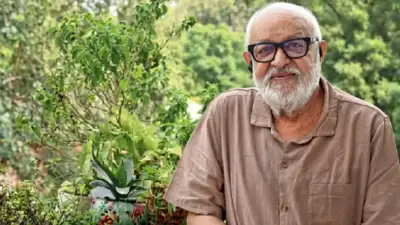
Food historian Pushpesh Pant at his Dwarka apartment
Now, approaching 80, Pant still speaks with the speed of a Swiggy delivery guy trying to beat a deadline while he explains how his earliest lessons in life and food were homemade.
“I would feel self-important,” he recalls. The home kitchen would produce a gastronomic version of mini India smelling as much of “sambar” as “shami kabab”. “My father would say, today I feel like a Gujarati, make me some lahsuni kadhi”. We would even distinguish if the dish was ‘Ghoti’ or ‘Bangal’, the traditional social sub-groups with distinct cuisines,” he says.
Multi-tasking came easily to Pushpesh Pant. A generation of JNU students of international affairs would remember his lectures on diplomacy. Along with writer Krishna Sobti, Pant was also the principal researcher for Ramesh Sippy’s iconic television series, ‘Buniyaad’. The unassuming director of ‘Sholay’ would visit Pant’s home, borrow John Updike’s short stories collection. The JNU professor would also translate Prime Minister Rajiv Gandhi’s speeches from English to Hindi. The food for thought brewed into a transformative moment for Pant. Childhood had drilled in him a taste for diverse cuisines. But as an academic, he also saw food through the looking glass of culture and class, where caste and community reflected their personalities through their culinary fare. Which is why his switch from diplomatic desk to dinner table has produced a smorgasbord of food histories and television shows, notably ‘Raja, Rasoi aur Anya Kahani-yan’, which gave commoners an insight into royal kitchens. Mostly homeschooled by his mother, he grew up in the restorative hill settlement of Mukteshwar, where his father served as a doctor in the Imperial (now Indian) Veterinary Research Institute. “He had a Bengali roommate during his years at Lucknow’s King George’s Medical College. He could speak and abuse in Bengali,” Pant smiles. In the city of nawabs, his father also developed a fondness for kebabs and kormas. Another day my mother could prepare ‘doi maach’. Culinary variety was outside too. Research scientists at the institute came from different states. “The Sindhis would make crispy ‘aloo tuk’ and ‘seyal gosht’. But those were pre-pressure cooker days. Cooking meat in the hills would take four hours,” the food historian recalls. With the passage of time, Pant understood that food wasn’t just taste but also ritual. “My mother was a devout Hindu. Poornamashi (full moon night) meant falahar (a meal of fruits). But we also loved the koftas and kimami sewai sent by a Muslim family friend from Shahjahanpur during Eid. There were no taboos,” he remembers.