

Site of the discovery in central Paris. (Photograph: Simon Wohlfahrt/AFP)
The roughly 65-foot wall, dating from the Gallo-Roman period, was discovered this summer on the Île de la Cité, a stone’s throw from Notre Dame Cathedral in the heart of the city. The wall emerged from excavations that began in February 2026 ahead of a restructuring of the Hôtel-Dieu hospital, with the dig led by David Couturier of the City of Paris archaeology department, supported by France’s National Institute for Preventive Archaeological Research (Inrap). Paris Mayor Emmanuel Grégoire visited the excavation site as the findings were announced this week.
An ancient wall unearthed beneath the courtyards of Paris’s Hôtel-Dieu hospital has been described as a “major breakthrough” by France’s culture ministry, with the archaeological find possibly confirming the location of the city’s original settlement. Regional archaeology curator Stéphane Deschamps said the new find helps settle that long-running question, noting that, lacking tangible evidence on the island itself, some researchers had even proposed Nanterre as the true site, a gap this wall and its surrounding context may finally close. Heritage curator Dorothée Chaoui-Derieux said the wall’s large blocks and interlocking beam system immediately pointed to Gallic construction traditions rather than a later Roman build. “We may be looking at one of the most important remains ever discovered for understanding Gallic Lutetia,” Culture Minister Catherine Pégard said in a statement from her ministry.
The Île de la Cité has traditionally been regarded as the centre of Lutetia, but a rival theory, backed by archaeological research, contends that it was instead in Nanterre, a suburb to the west. She added that scientific caution still requires verifying the wall’s function and chronology, but that the convergence of evidence is particularly remarkable at this stage.
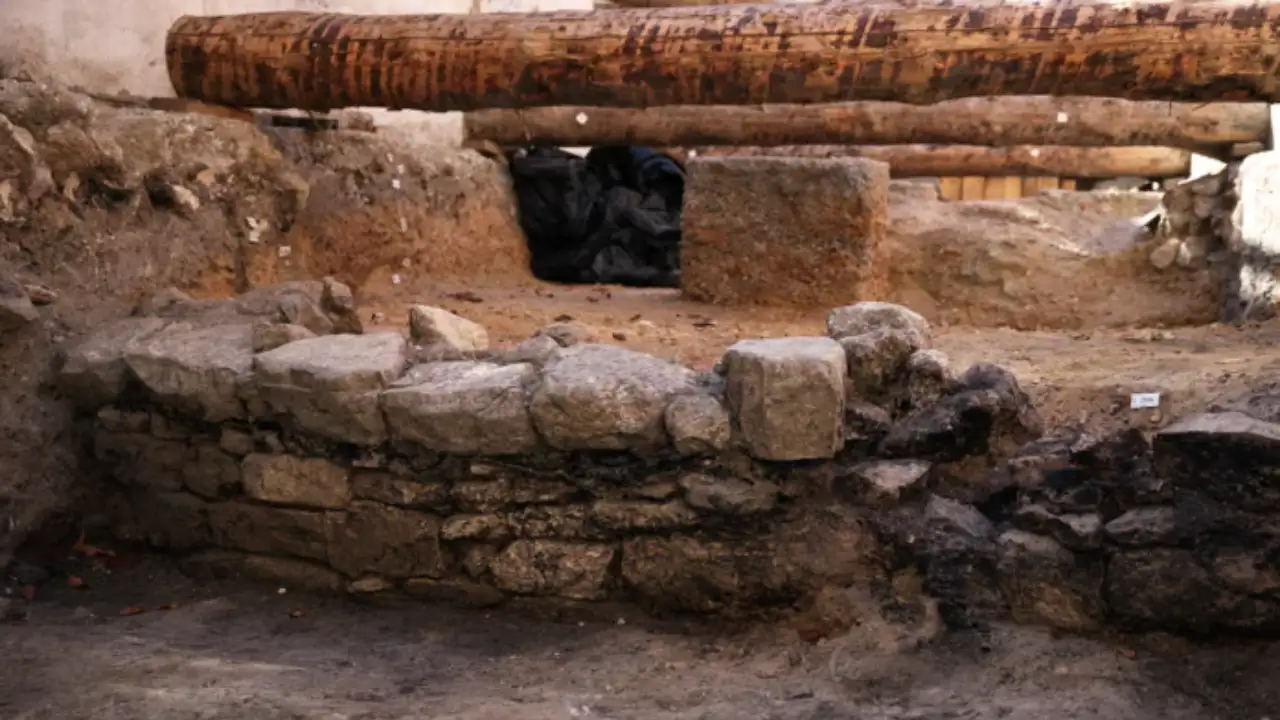
Carbon dating of the charred evidence places it between roughly 10 and 200 BC, a timeframe that encompasses the Battle of Lutetia in 52 BC. Archaeologists also found a roughly six-foot-thick platform of sand and gravel behind the wall that may have reinforced it, along with burned seeds and a Gallic spearhead nearby. Fire had blackened the wall’s outer face and destroyed a wooden structure standing just in front of it.
The wall bears traces of fire, which may correspond to Caesar’s account that the Gauls set fire to their own town before the Battle of Lutetia against the Romans.