Abhishek Sharma
It came two years ago, for Punjab against Meghalaya in a Syed Mushtaq Ali Trophy fixture nobody outside domestic cricket was watching: 28 balls, no fanfare. Somewhere in Abhishek Sharma’s memory, though, there’s a faster century still.
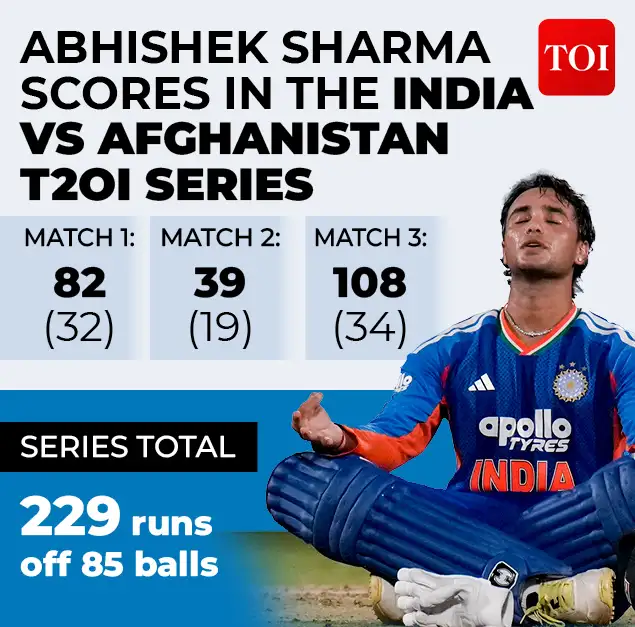
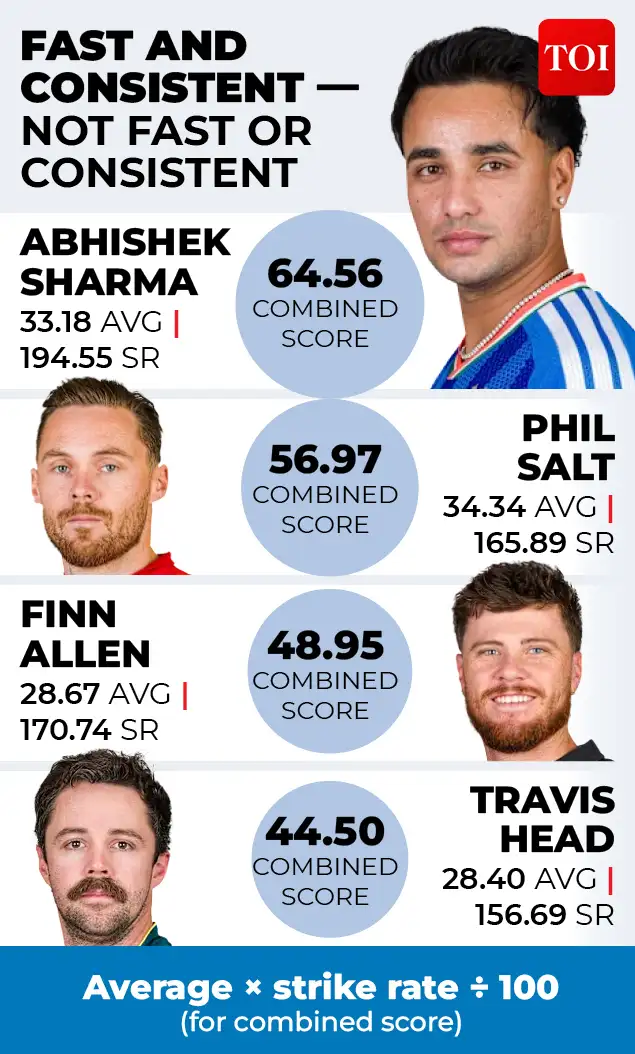
Eight years earlier, on the same square when it was still called Feroz Shah Kotla, a 17-year-old Sharma walked out at number six for Delhi Daredevils against Royal Challengers Bangalore and top-scored on IPL debut — an unbeaten 46 off 19 balls. His strike rate in an innings’ first ten balls, 176, is the joint-highest on record, level with Tim David: he isn’t feeling out the pitch before he attacks. His boundary percentage inside the powerplay, 33.48% according to CricViz, is the best among batters with 500-plus T20I runs. India have breached 90 in a T20I powerplay four times, and Abhishek has been the one doing the damage on every occasion: 59 not out off 21 against England at the Wankhede last year, 51 not out off 14 against New Zealand in Guwahati this year, 51 off 19 in the World Cup final in Ahmedabad, where he reached fifty in 18 balls under the most pressure he’s likely ever faced. His 76 not out off 22 balls is simply the largest number yet on that list. His opening stand with Samson, 142 off 59 balls, is now the fastest century opening partnership for India in T20Is by run rate, overtaking a stand between KL Rahul and Rohit Sharma from Indore in 2017. Abhishek walked into this year’s T20 World Cup and made three consecutive ducks, followed that with 15, 10 and 9, and salvaged the campaign with two match-defining fifties, one in a must-win Super Eight game against Zimbabwe, the other in the final. Eight innings, 141 runs, an average of 17.62. Against the Rashid Khan, Mohammad Nabi and Mujeeb Ur Rahman spin trio in the Afghanistan series, he made a conscious tactical switch, going only forward or down the pitch, never back, and scored 54 off 15 against them, including 4, 4, 6 off three straight Rashid deliveries in the last over of the powerplay. In the first two games, camped on the back foot against the same bowlers, he’d managed only 29 off 17.
“As a batter, as a cricketer, sometimes [my form is] going to go up and down,” he said afterwards, and there’s little sense he sees the ducks as a separate problem from the sixes. “It’s always about me backing my shots because I don’t have a lot of shots,” he said earlier this year, after an 85 off 34 against New Zealand, which sounds like modesty until you notice how precisely that limited toolkit is being aimed. The ground has some history with him already. It was the innings that first put his name into circulation. Most sixes for India in a T2OI match The clearest expression of the method is the powerplay. This has happened before, too. None of this comes free. They’re the same bet, landing differently. What’s changed isn’t the risk-taking. It’s how deliberately he manages it.