
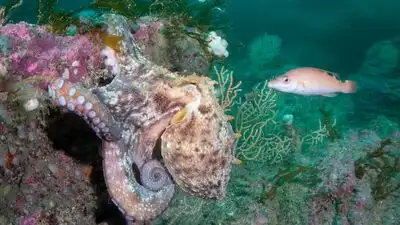
An octopus at Porthkerris reef, off Cornwall in southwestern England (Reuters)
European waters averaged 21.6°C between June and August, the highest summer average in a 45-year record dating back to 1982, according to a Reuters analysis. The warming has been particularly pronounced in the Bay of Biscay, a part of the northeastern Atlantic Ocean along the western coasts of France and northern Spain, where average sea temperatures reached 21.4°C during the summer, more than 2.4°C above the 1991-2020 average. The region also recorded 186 marine heatwave days by the end of August, highlighting the prolonged nature of the unusually warm conditions. Along the coast of Asturias in northern Spain, large brown kelp forests have declined sharply, with marine ecologist Jose Manuel Rico Ordas estimating that around 95 percent of the kelp stands sampled since 2010 have disappeared, according to Reuters. Octopus landings, which were below 30 tonnes a year before 2025, rose to around 2,600 tonnes in 2025 and have crossed 3,000 tonnes in 2026, according to figures cited by Reuters.
Because the underwater forests provide food and shelter for several marine species, including sea urchins, lobsters and crayfish, the loss of kelp is significant. With European waters recording their hottest summer on record, rising ocean temperatures are affecting marine life across the continent, damaging habitats and forcing several species into new waters. The prolonged warming is also affecting marine habitats. One of the clearest examples is emerging in southern England, where common octopus populations have surged as waters warm. The shift in marine life is also changing the catch for fishermen. others are seeing traditional catches such as crab, lobster and scallops decline, showing how warmer waters are reshaping Europe’s fisheries While some are benefiting from the sudden rise in octopus. In the Mediterranean, warmer conditions are helping non-native species expand into new areas, adding to existing pressures on native marine life and changing local food chains. Scientists say the changes are being driven by more frequent and intense marine heatwaves, which can affect the survival, reproduction and movement of marine species. As ocean temperatures continue to rise, species adapted to cooler waters may face increasing pressure, while warmer-water species can expand into new habitats. You use AI every day. Now get your AI Quotient. Take the AIQ test.
As waters warm, species that depend on cooler conditions can come under pressure, while warmer-water species are increasingly moving into areas where they were previously less common.