
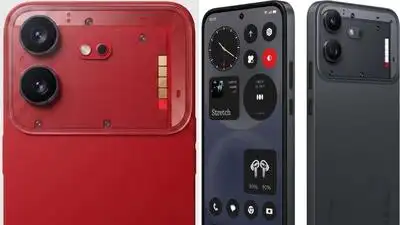
The Nothing Phone (4a) with 6GB RAM and 128GB ROM is priced at Rs 39,999, while the 6GB RAM model of Phone (4b) costs Rs 35,999. Other models of the Nothing Phone (4b) are 8GB + 128GB and 8GB + 256GB’ priced at Rs 39,999 and Rs 40,999, respectively. Nothing Phone (4a), on the other hand, is offered in 8GB + 128GB, 8GB + 256GB, and 12GB + 256GB options with price going up to Rs 50,999.
Nothing has introduced new RAM variants of its Phone (4a) and Phone (4b). The smartphones are now offered with 6GB RAM and a storage capacity of 128GB. Both smartphones can be purchased via Flipkart in the country along with authorised retail sellers.
The new Glyph Bar uses a grid of 45 mini-LEDs split across five squares with no light ‘bleeding’. The smartphone also gets the larger 5,400mAh battery in India, 50W wired charging, and the same software package—Android 16 with Nothing OS 4.1, 3 OS updates, and 6 years of security patches.
Nothing says it has overhauled its signature light interface on the back. Nothing Phone (4b) fuses the well-accepted design with durable polycarbonate unibody of the Phone (4a) Pro and the fan-favorite Glyph Bar from the Phone (4a).
On the front is a 6.77-inch Super AMOLED display with a 120Hz refresh rate and a fast in-screen fingerprint sensor. Powered by the new TrueLens Engine 4.0 and an Ultra XDR mode co-developed with Google, the camera snaps 13 separate RAW photos at different exposures and instantly blends them together for stunningly real-life colours. The Phone (4b) packs the longest-lasting battery of any Nothing phone to date: a 6,000 mAh battery into the Indian variant with impact-resistant Safe Cell Technology, extending the battery’s lifespan to retain 90% of its health even after 1,200 charges. The phone is IP64 certified for dust and water resistance, is 20% more bend-resistant than the Phone (3a) Lite. Nothing Phone (4a) runs the Snapdragon 7s Gen 4—a modest step up from the 7s Gen 3—with LPDDR4X RAM and no vapour chamber. Its 6.78-inch 1.5K 120Hz AMOLED display peaks at 4,500 nits. The (4a) sticks with a plastic frame at 8.55mm and is rated IP64. Instead of the Glyph Matrix, it gets a Glyph Bar with 63 mini-LEDs reaching 3,500 nits—40% brighter than the (3a).
Users can visually track Uber rides, food deliveries, timers, and battery charging progress via the back lights. Users can set up custom light flashes for specific contacts or even configure the lights to flash when live cricket scores change. Coming to the cameras, the Phone (4b) features a 50MP main camera equipped with dual-axis Optical Image Stabilization (OIS) to prevent blurry shots, alongside an 8MP ultra-wide lens. One of the phone’s biggest selling points is its battery life. The camera setup is nearly identical to the Pro, swapping in a Samsung GN9 sensor for the main camera instead of the Sony unit, with Ultra XDR limited to 1080p 30fps.