
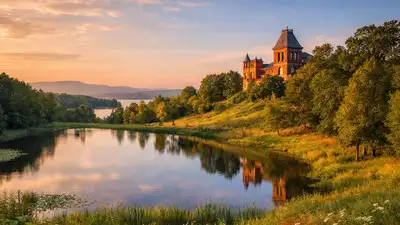
AI representation: Hand‑dug lake at Olana State Historic Site, surrounded by thousands of native trees. Image credits: Chatgpt
In 1860, Church purchased a 126‑acre farm two months before marrying Isabel Carnes, according to the Olana Partnership’s official history of the landscape. Activity surged in 1878 and 1879, when Church wrote that the lake was overflowing and his birch canoe was ready, according to Olana’s history of the landscape. There were two roads built in 1884, namely Ridge Road and Crown Hill Road, which guided people through a unique land formation. In an August 1887 letter to the writer Charles Dudley Warner, cited in the journal Art History, Church said he was busy “landscape architecturing.
He called the property “The Farm” and operated it as both a working and ornamental farm. In an 1884 letter, according to Olana’s history of the landscape, he wrote that building roads let him make more and better landscapes than “tampering with canvas and paint” in the studio. Throughout the years, Church acquired additional acreage, which included the hillside known as Sienghenberg, upon which he constructed his primary residence with help from the architect Calvert Vaux. The basin was already holding water and in use while the twenty years of excavation were still underway. The lake served purposes other than aesthetic ones. It was used for boating, skating, and fishing. The lake also supplied water. Dynamite was used to blast certain routes, and workers covered the roads with red shale mined from the property.
Church installed a system that pumped it up to a cistern in the main house, and water is still pumped from the lake to a water tower near the main house today.
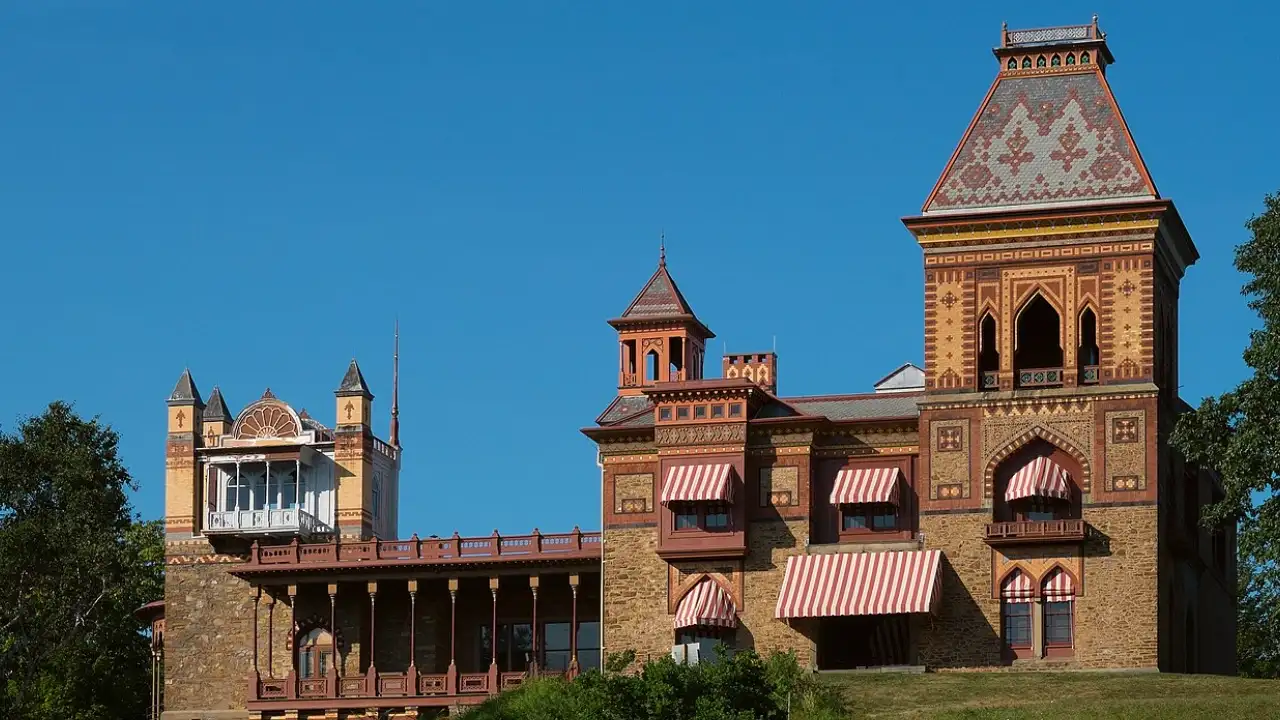
Olana was preserved from demolition in 1966, and from that time restoration and stewardship have tried to reclaim elements of the design created by Church while preserving Olana as a historic public site. The work has included dredging the lake and managing aquatic invasive plants so that the full water surface stays visible. In addition, second growth of woodland and invasive plants have been removed to restore the view of the Hudson River, and the fields of farms have been uncovered together with stone walls. The North Meadow restoration is under way. The place that visitors walk around is thus not only a historic document but also a living project. A lake dug largely by hand and thousands of trees planted under one artist’s direction, created a personal landscape that later became a public one.