
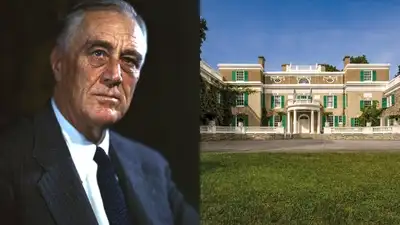
Portrait of Franklin D. Roosevelt alongside Springwood Estate at Franklin D. Roosevelt National Historic Site. Credits – Wikimedia Commons
Roosevelt purchased his first saplings in 1912, the year he was appointed chairman of the New York Senate’s Forestry Committee, according to the National Park Service . By the 1930s the estate was taking in somewhere between 20,000 and 55,000 new trees a year, and the habit continued until his death in 1945. A crop not a view Eventually, the estate swelled to about 1,600 acres. Some 800 acres were native woodlands, 400 acres were orchards, pastures and tilled fields, and the remaining 400 acres were set aside for Roosevelt’s tree planting, with about 250 of them carrying established plantations by 1943. In 1930 he teamed up with Nelson C. Between 1930 and 1933, the college established 36 plantations with roughly 88,600 trees. After 1933, according to the National Park Service, Brown served for twelve more years as Roosevelt’s unofficial and unpaid forest manager, helping him expand the programme and begin Christmas tree production on a large scale. In 1943 Brown reported the results in the Journal of Forestry , noting that the family woodlands then held 800 acres of natural growth and 250 acres of plantations. Roosevelt sent trees from Hyde Park to Winston Churchill, and the NPS archives hold memos to the estate manager, William Plog, about the 1943 Christmas tree gifts.
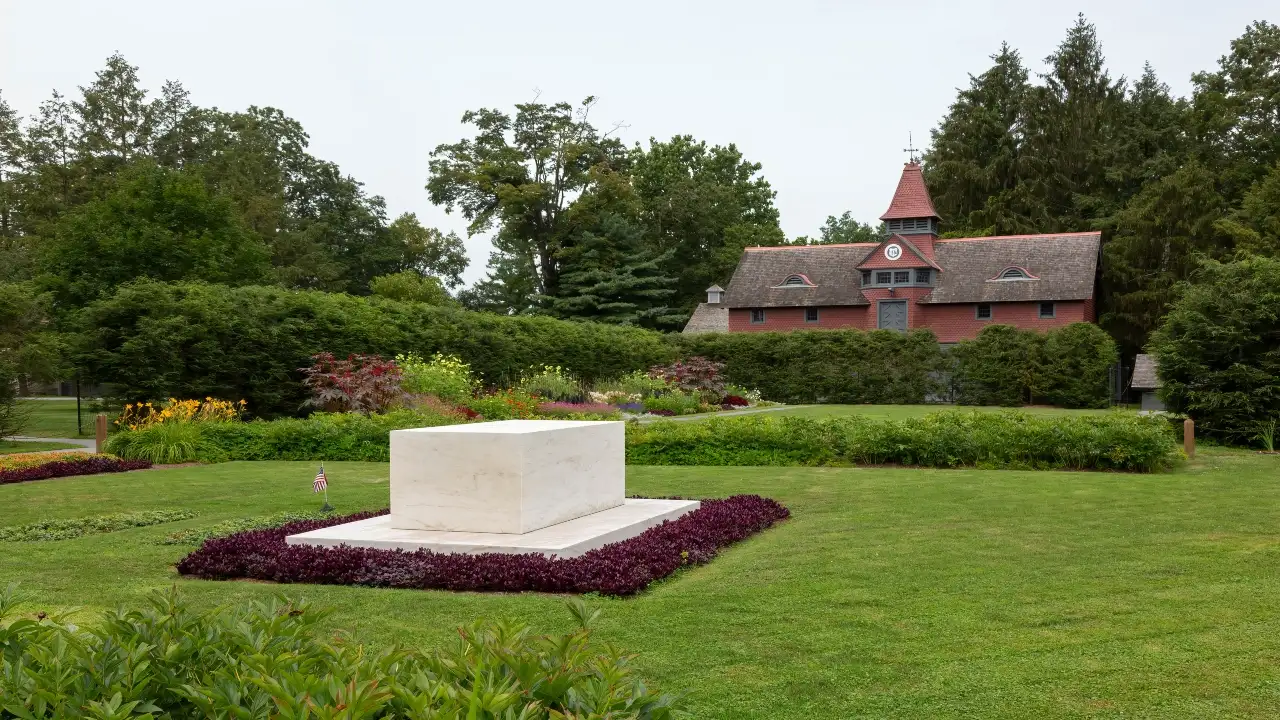
The park agency says he saw his woodlots as a crop rather than scenery, and he wanted the property to stay productive for the long term. Most people will likely cite sailing or stamp collecting when asked what Franklin D. Roosevelt did to unwind. Foresters typically respond differently. The record demonstrates that Roosevelt took his self-described status as a tree farmer seriously. He spent most of his adult life transforming steep slopes and dilapidated fields into functioning woods on the family property at Hyde Park in the Hudson Valley of New York. People are surprised by the scale. He would plant close to half a million trees over the following three decades. Behind those numbers sits a bigger question. Was the endeavour a wealthy man’s hobby, or something closer to a field experiment that shaped how America thought about reforestation? The evidence leans towards the second. The difference was his approach to those plantations. He did not labour alone. Brown, a professor of forestry at the New York State College of Forestry at Syracuse University. A neighbour had shown what was possible. The conservation group Scenic Hudson cites the railway magnate Archibald Rogers, who planted a tree farm on his Hyde Park estate and gradually trimmed it as the trees matured. Roosevelt learned from the example and then pressed on, with a trained forester at his side. Trees that earned their keep Some plots were purely experimental or demonstration plantings, which turned the estate into what the park service describes as a learning laboratory that gave others data. The most recent felling had supplied oak and shipbuilding timber for the war effort, a reminder that a gentleman’s wood had become a real source of wartime material. Christmas trees were something of a hallmark crop. It was a telling detail, and it showed how seriously the operation was run. There were managers, records and a market. He was not simply a man with a shovel. The grave of Franklin and Eleanor Roosevelt is located in Hyde Park, New York. Credits – Wikimedia Commons
The best representation of that philosophy is the Civilian Conservation Corps, created in 1933. The Department of Environmental Conservation says Roosevelt had a specific interest in forestry and began planting his estate with seedlings from the state tree nursery in 1912. Work slowed again during the war years, from 1941 to 1945.
Hyde Park to national policy To imply that one estate designed America’s tree-planting schemes is going too far. Roosevelt had numerous advisers, and forestry science was rapidly advancing over these decades. But he arrived at the White House fully convinced, from his own soil, that planting trees at scale was practicable, measurable and worth public funds. Let New York’s own records tell the tale. The Depression cut state financing for tree planting, but the Corps revived the scheme, planting millions of saplings in barren soil and giving jobs to thousands of young men. The Hyde Park plantings are a handy reminder that big conservation movements often start with someone testing an idea on their own land. Roosevelt planted hundreds of thousands of trees, kept detailed records with professional help, and then carried the same confidence into national policy. You use AI every day. Now get your AI Quotient. Take the AIQ test.
Many of those trees still stand in the Hudson Valley today.