
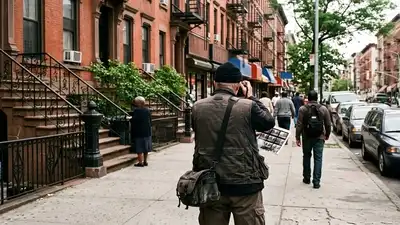
AI-generated representative image. Credits – Gemini
He has spent nearly five decades photographing America’s changing cities, and the Library of Congress holds his photograph collection, with more than 5,000 chosen best pictures, held in its Prints and Pictures Division. A camera and a sociologist Born in Santiago, Chile, in 1944 to a rich family, Vergara’s family was broke by the time he was fifteen. He moved to the United States and earned a bachelor’s degree in sociology from the University of Notre Dame in 1968, followed by a master’s degree in sociology from Columbia University in 1977. Twenty-six images of one address The narrative of 65 East 125th Street is told by the National Endowment for the Humanities, which honoured Vergara with the National Humanities Medal in 2012. Vergara started shooting it in 1977, and his first image shows crimson double doors, cocktail glasses painted on the front, and a sign for the Purple Manor. By 1980 the doors were black and white, and a restaurant advertised fish and chips for $2.25. The building was a bargain variety store in 1981. In the final picture of the 26-image sequence, taken in 2009, the space was for rent. The 26-image sequence is one part of Vergara’s broader long-term documentation of Harlem and other American cities.
Because he returns to the same vantage points over long periods, the library notes that his photographs show how areas can fall into decay and, in some cases, come back to life.
He has said his mission was to document the damage and violence that had affected New York during a period of urban crisis. Photographs typically capture a moment. A single shot can depict a street on a specific afternoon, but it cannot reveal the street’s subsequent developments. A few documentary photographers have attempted to address the issue by repeatedly returning to the same location, which is a methodical and somewhat obstinate approach. One of them is Camilo José Vergara. That background influenced his attitude. In the early 1970s, when he first picked up a camera, he concentrated on people living in damaged areas. With time he turned his attention to the buildings and streets themselves, which he came to consider as a more reliable record of the choices made by residents and city officials over the long haul. His projects now span New York, Newark, Camden, Detroit, Chicago, Gary, Los Angeles and Richmond, California, among others. It is located on the main Harlem artery between Madison and Park Avenues. The changes are coming fast. Then it became a smoking shop, a unisex boutique, a beauty shop, a clothing store and a Sleepy’s Mattress Store. Vergara positioned himself in the same spot for each picture and used equivalent cameras and lenses so the images could be compared directly. Multiply that discipline across dozens of locations, and you have a kind of visual data set. AI-generated representative image. Credits – Gemini Breaking up, then reshaping differently Vergara’s Harlem is a place of wreckage and rebirth. A review in Reviews in History notes that new and restored buildings are attracting more affluent Black and Latino residents, along with some white residents. It also notes that chain businesses now line much of West 125th Street, while national retailers and new condominiums have displaced some long-standing businesses and residents. Researchers at Rutgers’ humanities institute make a similar argument. They note that many symptoms of ghetto life, including physical deterioration and social dysfunction, emerge in the book, but so do signs of metamorphosis, some of them striking. They also point out the discomfort that gentrification has created in a long area called the capital of Black America. The Library of Congress study guides lay out the balance clearly. Some communities degrade as long-established businesses give way to vacant shopfronts, graffiti and garbage, while others gentrify. Vergara also captures the street life that persists through it all, such as stoop parties, parades and paintings.
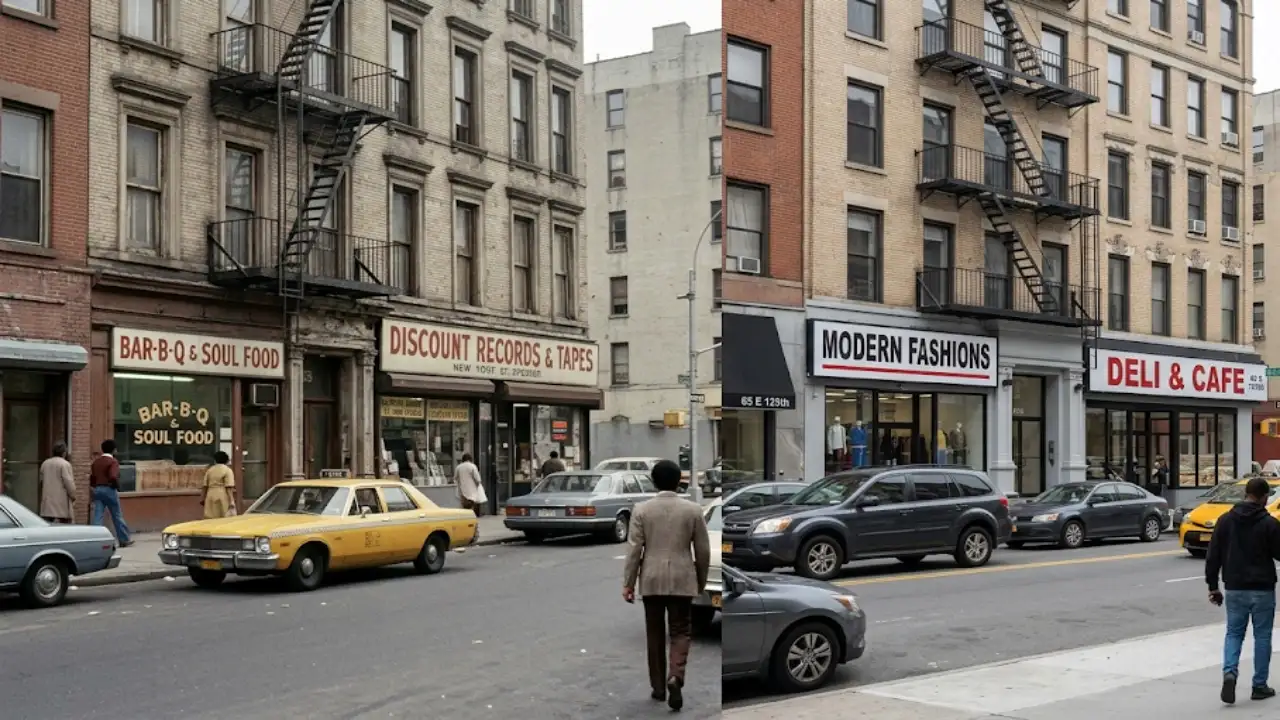
Invincible Cities, an interactive website supported by Rutgers University and the Ford Foundation, makes Vergara’s time-sequenced photographs from Harlem, Richmond and Camden available online. The patience of his record is its strength. Vergara does not tell readers whether the changes are positive or negative; he simply documents how places change over time, leaving the interpretation to viewers. You use AI every day. Now get your AI Quotient. Take the AIQ test.