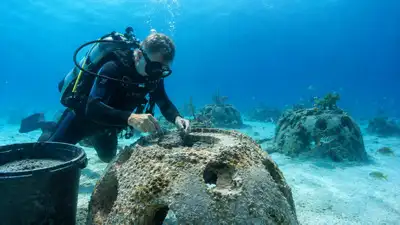
Representative image of an underwater memorial reef made from concrete structures that have become thriving marine habitats. Image Credits: ChatGPT.
By 2023, Eternal Reefs reported that more than 2,500 memorial reefs had been placed at about 25 locations. On May 1, 1998, ten Nautilus and 20 Aquarius reef balls were cast, including the one containing Palmer’s remains.
The story began in 1998, when Don Brawley incorporated his father-in-law Carleton “Petey” Palmer’s cremated remains into a concrete artificial reef, according to The Washington Post. Don Brawley and Todd Barber were college roommates who often dived in the Florida Keys and became concerned about the deterioration they saw on the reefs, according to Eternal Reefs. In 1998, Brawley’s father-in-law, Carleton “Petey” Palmer, told him that he wanted his cremated remains to become part of a reef.
What began as an unusual request from a dying man became a new way to remember people while creating habitat beneath the sea. The memorial reef was cast in Sarasota, Florida, and later placed on the Gulf of Mexico floor. Palmer’s request eventually led to Eternal Reefs, which has deployed thousands of memorial reefs at permitted sites along the US coast. An unusual request becomes a new kind of memorial The story began with an artificial-reef project rather than a funeral service. They began looking for a way to recreate marine habitat and eventually developed Reef Balls, hollow concrete structures with textured surfaces designed to provide places where marine organisms could settle and grow. The Reef Ball Development Group and Reef Ball Foundation went on to develop and deploy these structures as artificial reefs in different locations. The idea of turning a reef ball into a memorial came from a much more personal request. When Palmer died, Brawley remembered what he had asked for and decided to make it happen. Palmer’s cremated remains were mixed into the concrete used to make a reef ball that was to be placed in the sea near Sarasota, Florida. Once placed on the ocean floor, it became what Eternal Reefs describes as its first memorial reef. Rather than simply marking a final resting place, the structure was intended to become part of the underwater environment, providing a surface where marine organisms could settle and grow. What began as one man’s unusual final wish eventually became the idea behind a new kind of underwater memorial. How ashes become an artificial reef
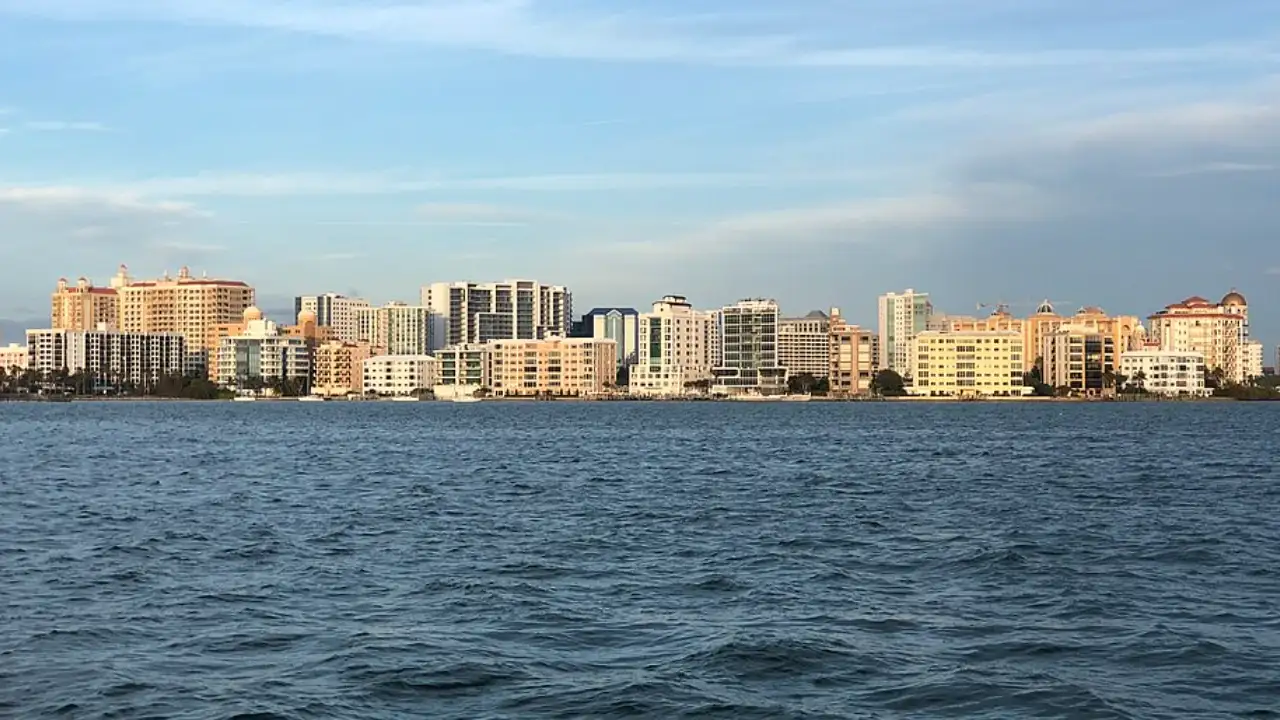
Sarasota Skyline from Bird Key Park, January 2018. More than 25 years after Palmer’s reef was created, the basic process remains much the same. From one family’s wish to thousands of reefs After Palmer’s reef was placed in the Gulf, other families began asking Brawley if they could do something similar for people they had lost.
Its memorials are placed at public reef sites established for recreational activities such as fishing and diving, according to Eternal Reefs. Eternal Reefs’ process involves mixing cremated remains directly into marine concrete to form a reef memorial structure. Families can take part in creating the memorial by mixing the ashes into the wet concrete and adding handprints, notes, or other environmentally friendly items. The finished memorial is then allowed to cure before being deployed at an approved marine location. Design plays a crucial role in the functioning of the memorial beneath water. The reef balls have holes that let water pass through them, and their textured surface gives marine species a place to attach. Over time, algae, invertebrates, and other marine creatures colonise the structure, while fish use the holes inside and around it. This does not mean the structure becomes a coral reef in the strict sense. This is an artificial reef meant to provide additional habitat. The structure’s ecological value depends on its location and the marine ecosystem at the chosen site. The idea later expanded beyond individual memorials. The company’s schedule currently includes reefs in Florida and other coastal areas. Image Credits: Wikimedia Commons. The idea offered a different way to remember someone. For some families, it was an alternative to keeping cremated remains in an urn or scattering them. For others, the appeal was that the memorial could also have a place in the sea, where it could eventually become part of the marine surroundings. Cremated remains are incorporated into a concrete reef structure, which is then placed at an approved marine site. Over time, marine organisms can settle on the structure and around it, making the memorial part of the underwater landscape. What started with one family’s request eventually opened the door for others who wanted to remember their loved ones in a place connected to the sea. You use AI every day. Now get your AI Quotient. Take the AIQ test.
Today, Eternal Reefs offers group deployments at permitted coastal locations, allowing several families to have reefs deployed in a single operation.