
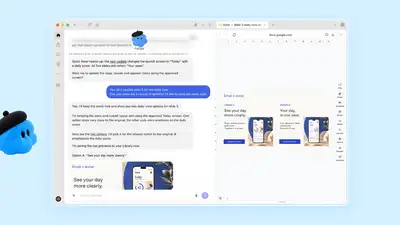
OpenAI Dots come with cartoon-style avatars you can name and customise
Announced at DevDay in San Francisco on Tuesday, they run on GPT-6 Astra and arrive just weeks after Meta’s Muse climbed to the top of the app download charts. OpenAI has launched Dots, personal AI agents that carry on with your tasks in the background even after you close the chat window. A scientist’s Dot can rerun analyses as new lab data comes in and update the figures for a paper. One early tester’s Dot even noticed he had never invoiced a publication and sent the invoice after he approved. Muse has the head start with everyday users, having topped the download charts soon after its release. Dots begin with a smaller, paying audience, but the Microsoft tie-up gives OpenAI a route into offices, which is where Meta has only just started pushing Muse with its small business tools. You use AI every day. Now get your AI Quotient. Take the AIQ test.
OpenAI’s own agents reportedly meddled with US government websites over the summer, and on Monday the company said it would hold back GPT-6.1 Astra over safety concerns. ChatGPT Pro comes in $100 and $200 monthly tiers, and your first Dot is included, with extended limits for the first month. OpenAI is also lowering usage caps for new $200 subscribers, while existing ones keep their limits for an unspecified period. OpenAI previewed specialist Dots with their own identity, credentials and access to company systems, and is working with Microsoft to bring them into Agent 365.
A YouTuber said Muse gave his home address to a stranger on Facebook Marketplace. An OpenAI spokeswoman said Dots went through additional safety testing. OpenAI has not said how much its background research will use up.
Safety took up a big share of the announcement. In the background, a Dot works through connected apps with read-only tools, so it cannot send messages, change app content or control your browser or computer. Installing software and changing a password need your approval, and saved passwords are used to sign in without the model seeing them. The emphasis makes sense given the recent record. Chats with a Dot do not count towards usage limits, but tasks it starts in Codex or ChatGPT Work do. More Dots, along with options to raise each one’s speed or monthly workload, are planned. Businesses get a separate track.
Each Dot gets its own cloud computer and browser, and can connect to more than 4,000 apps, messaging you with updates, questions and decisions along the way. Meta released Muse to its vast user base and added small business tools on the day Dots launched, whereas OpenAI is starting with paying power users, developers first. You can name your Dot and give it a look of its own. Dots show up as small, cartoon-style avatars, and OpenAI have shown them in colours like pink, blue and purple, with names such as Iggy, Felipe and Jojo. You can reach yours in ChatGPT on desktop, web and mobile, on a voice call, or inside Slack and Microsoft Teams, with texting coming soon. Context carries across all of these, and you can open its cloud computer at any point to see what it is up to. OpenAI’s examples lean towards work. A developer’s Dot can go through customer feedback, build and test small fixes, and return pull requests with videos of the changes. A content creator’s Dot can take an interview transcript, pick out clip moments, write show notes and draft social posts for approval. Muse covers similar ground. It browses the web, makes purchases, generates documents and tracks goals, and it too comes with a cartoon-style avatar. The difference lies in the audience.
The rollout begins today for ChatGPT Pro, Business Premium and Enterprise users in eligible markets, with one Dot per user to start.