
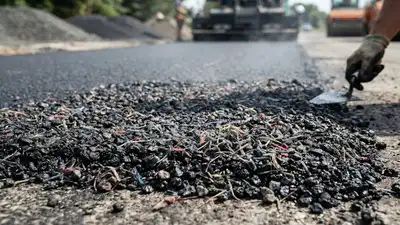
AI-generated representative image showing recycled carpet fibers being incorporated into asphalt for road construction. Credits – Gemini
A 2005 North Carolina State University study tested recycled nylon carpet fibers in asphalt to examine whether they could improve resistance to fatigue cracking. Published in the Textile Research Journal , the study found that samples containing the optimal fiber combination had 85% higher fracture energy than asphalt without fibers, indicating improved resistance to fatigue cracking. The researchers, armed with this amount, prepared samples of asphalt with fibres of two lengths, 6 and 12 millimetres, added at 0.25, 0.5 and 1% of the mix by volume. The best performing sample was 12-millimetre fibres at 1% by volume, with 85% more fracture energy than asphalt without fibres.
The study suggests that recycled carpet fibers could improve asphalt’s resistance to fatigue cracking. It was a laboratory finding, not a live road result, and the fibres were nylon, the kind used on the face of carpets. Still, the results pointed to a feasible means to reuse tough waste and extend the life of roadways. Then they conducted indirect tensile strength testing, a routine procedure that slices a cylinder of asphalt across its breadth. AI-generated representative image showing a laboratory test of asphalt reinforced with recycled carpet fibres to assess its resistance to cracking. Credits – Gemini
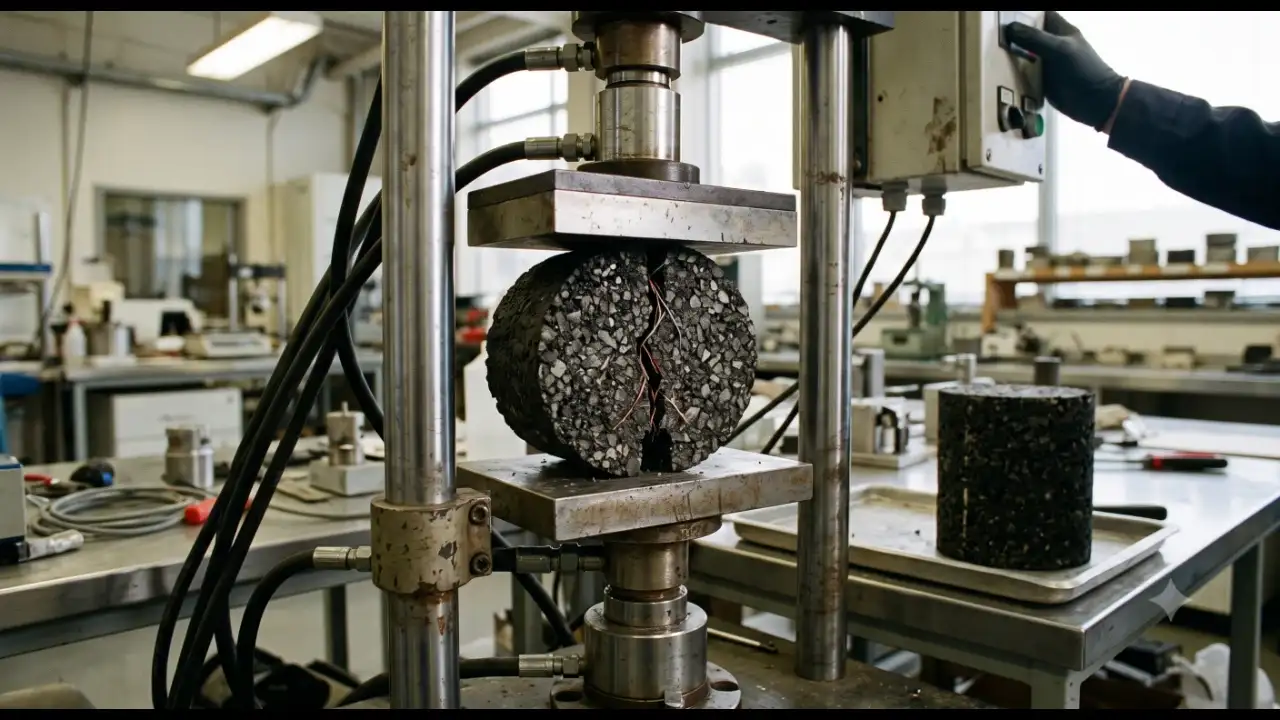
Earlier research had already tested waste fibers In a 2004 study published in Resources, Conservation and Recycling , Bradley Putman and Serji Amirkhanian examined waste tire and carpet fibers in stone matrix asphalt, a rut-resistant mix used on heavily trafficked roadways. The 2005 experiments used nylon carpet fibers, while a separate 2004 study had already examined waste carpet and tire fibers in stone matrix asphalt. The 2005 North Carolina study found 85% higher fracture energy at the best fiber setting.
In such a mixture, adding fibres generally prevents the thick binder from draining off the stone, allowing waste fibres to perform the same function as manufactured ones. The authors noted that people commonly dump waste fibres in landfills and that using them would ease the load on those sites. More fibre is not necessarily better than less. Studies of various types of fibre show that resistance to cracking rises to an optimum level and then diminishes. Nor can a lab sample replicate years of traffic, heat and rain; thus, field trials on real roads remain the only honest test. Later work on waste fibres in asphalt suggests the concept is viable. What’s missing is long-term proof on real roads. Until then, reclaimed carpet is a sensible, low-cost idea worth watching and not yet a ready-made fix.