
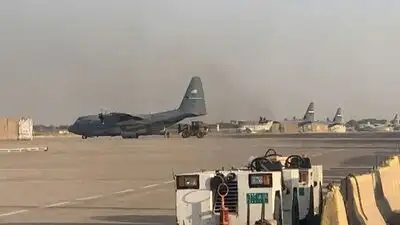
The withdrawal of US troops from Iraq signifies a pivotal change in the nation’s security landscape.
US forces departed in 2011, only to return less than three years later when ISIS swept across large parts of Iraq and Syria. This time, the final troops left mainly from an airbase in Erbil in the semi-autonomous Kurdistan Region on September 30, formally concluding the latest chapter of America’s military presence in Iraq. Twenty-three years after American troops crossed into Iraq to overthrow Saddam Hussein, the last US forces have left the country. It is not the first time Washington has withdrawn. But the departure leaves Iraq with a question that is bigger than the presence of American troops: what happens when the security responsibility is entirely its own? For Baghdad, the withdrawal is a powerful statement of national sovereignty and puts greater responsibility on Iraq’s security institutions. For the Kurdistan Region, however, it removes a crucial security partner at a time of intense regional conflict. And across Iraq, questions remain over ISIS sleeper cells, powerful armed groups and whether the state can establish effective control over the use of force.
The current departure closes the latest chapter of a history that began with the US-led invasion of Iraq in March 2003, which overthrew Saddam Hussein’s government. US forces formally withdrew in December 2011. In 2014, the group captured Mosul and large parts of Iraq and Syria. ISIS lost its territorial strongholds in Iraq by 2017. US personnel remained in support, training, intelligence and counterterrorism roles Although the coalition’s combat mission formally ended in 2021. The September 2024 agreement ultimately set the path for the latest US military withdrawal. Under the two-stage plan agreed by Washington and Baghdad, the coalition’s military mission in Iraq was to conclude by the end of September 2025. Iraq would then continue to provide a platform for coalition support to counter-ISIS operations in Syria until September 2026. The group now operates primarily through clandestine networks rather than the large territorial structure it controlled between 2014 and 2017. Created in 2014 to fight ISIS, the PMU is an umbrella organisation containing numerous armed formations and has since become part of Iraq’s formal security architecture. In his September 25 address to the UN General Assembly, Prime Minister Ali Faleh Al-Zaidi said Iraq was committed to ensuring that the state remained the ultimate authority over war and peace and that weapons and instruments of force remained under constitutional institutions. Al-Zaidi had earlier pledged to disarm powerful Iran-aligned militias by September 30, 2026, the same date set for the withdrawal of the remaining coalition forces. He has since indicated that the broader process of bringing armed groups under state control could run until June 30, 2027. The arrangement developed after the 2003 invasion, when the US-led Coalition Provisional Authority created the Development Fund for Iraq. Speaking at the 81st UN General Assembly on September 25, Prime Minister Ali Faleh Al-Zaidi said Iraq wanted the state to have the final authority over decisions of war and peace and for weapons to remain under constitutional institutions.
Because the Kurdistan Region is an autonomous federal region rather than an independent state, and its relationship with Baghdad remains complicated by disputes over oil revenues, budgets, territory and the limits of Kurdish autonomy, the issue is especially sensitive. The withdrawal could therefore increase the importance of security coordination between Erbil and Baghdad. The US withdrawal therefore does not mean the ISIS threat has disappeared. Control over weapons therefore remains one of Baghdad’s major post-withdrawal challenges. The focus of the sovereignty debate therefore shifts from **foreign forces inside Iraq to who controls the use of force inside Iraq**. The US departure could therefore increase pressure on Kurdish leaders to strengthen coordination with Baghdad while reassessing their wider regional security relationships. The significance of September 30 therefore extends beyond the departure of American troops.
The end of the US military deployment raises questions about the future availability of American intelligence, surveillance and technical support, although the Pentagon has said Washington will continue providing targeted training and intelligence assistance to Iraqi partners. Al-Zaidi highlighted the **Development Road**, which aims to connect the Grand Faw Port with Türkiye and European markets, and said Iraq wants to develop its energy potential and strengthen its position as a regional economic and energy hub. Washington had justified the invasion partly through claims that Iraq possessed weapons of mass destruction, but no stockpiles were subsequently found. The invasion was followed by insurgency, sectarian violence and years of instability. The rise of ISIS changed the situation. At Baghdad’s request, the United States returned with an international coalition to support Iraqi forces, alongside Kurdish Peshmerga units and other partners. A smaller contingent remained in the Kurdistan Region, making the final departure from Erbil particularly significant. The timing is also important. Iraq has been caught between competing US and Iranian interests during a period of wider regional confrontation. Kurdish territory and American positions in northern Iraq have faced drone and missile threats during the recent conflict. For Baghdad, the withdrawal means assuming greater responsibility for national security. For Erbil, it means losing a major military partner that provided intelligence, training and other security assistance. The Kurdistan Regional Government has raised concerns about the loss of US security capabilities following the American withdrawal. The territorial defeat of ISIS did not eliminate the organisation. Iraqi forces continue to conduct operations against ISIS remnants. Iraqi security forces will now have greater responsibility for preventing ISIS from rebuilding its capabilities. Instead, the burden of containing the remaining network increasingly falls on Iraqi institutions. Another major issue is the Popular Mobilisation Forces, or PMU/PMF. Most of its factions are Shia, including powerful groups with close ties to Iran, but the organisation also contains Sunni and minority formations. The central issue is the degree of autonomy and political influence retained by some constituent groups. Several groups rejected that deadline. The end of the US military presence does not eliminate Washington’s financial influence over Iraq. Iraq remains heavily dependent on oil revenues, while its access to the international dollar system remains closely connected to US-based financial institutions. Iraqi oil revenues are held through an account belonging to Iraq’s central bank at the Federal Reserve Bank of New York, giving Washington significant leverage over Iraq’s access to dollar transactions. The distinction is important: **the money belongs to Iraq, not the United States**. That eventually evolved into the current central-bank account at the New York Fed. The system provides Iraq with access to the international financial system while also giving Washington influence over the mechanisms through which Iraqi oil revenues are transferred and converted into dollars. This means military sovereignty and financial independence are not necessarily the same thing. He also described the end of the international coalition mission as the beginning of a new phase in Iraq’s relations with strategic partners, shifting the focus from military cooperation towards economic and development cooperation. For Baghdad, the withdrawal provides an opportunity to demonstrate that Iraq can manage its security without a permanent US military presence. But it also transfers greater responsibility to Iraqi forces. Baghdad must maintain counterterrorism capabilities, prevent an ISIS resurgence, protect critical infrastructure and manage competing armed groups. The militia issue is particularly important. If the Iraqi state cannot exercise effective authority over weapons, the departure of foreign troops alone will not resolve the country’s broader sovereignty challenge. For the Kurdistan Region, the calculation is more complicated. The US has been a major security partner for Kurdish forces, particularly since the fight against ISIS began. The loss of a permanent American military presence comes as Erbil faces continuing drone and missile threats. Kurdish political divisions also matter. The KDP and PUK maintain different relationships with Baghdad, Washington, Türkiye and Iran. Sovereignty for Baghdad, a new security test for Erbil The US withdrawal marks the end of a major chapter in America’s military involvement in Iraq, but it does not end the broader relationship between the two countries. Baghdad now has greater responsibility for national security, ISIS containment and control over armed groups. Erbil, meanwhile, must adjust to the loss of a major security partner. At the same time, Iraq remains deeply connected to the US-linked global financial system and continues to depend heavily on oil exports. It marks a transfer of security responsibility to Iraqi institutions — and a new test of whether Baghdad can consolidate state authority while maintaining security across the country, including the Kurdistan Region. You use AI every day. Now get your AI Quotient. Take the AIQ test.
Most US forces had already left bases in federal Iraq during earlier stages of the transition.
Washington has said it will continue targeted training and intelligence support, while the two countries are expected to retain cooperation in security, information exchange and economic relations. The withdrawal does not end the US-Iraq relationship. Iraq also remains deeply connected to the US-linked international dollar system. The United States, however, is not leaving Iraq’s broader diplomatic and economic landscape. Washington and Baghdad are expected to retain bilateral cooperation in areas including counterterrorism, intelligence, training, information exchange and economic relations. The security implications are particularly significant for the Kurdistan Region. Kurdish authorities have maintained a close security relationship with Washington for more than a decade, especially during the fight against ISIS. The region has also faced substantial drone and ballistic-missile threats during the recent regional conflict.