
Without going into operational details, Kamat said that sensors, unmanned platforms, secure communications, AI-assisted decision support systems and precision weapons used in the operation were developed by Indian R&D institutions
Kamat, who completed his PhD from Ohio in 1988, told graduates that he too was once at a crossroads. Kamat also recalled the Integrated Guided Missile Development Programme that began in Hyderabad in 1983 under A P J Abdul Kalam. Because the samarium-cobalt magnets made at DMRL relied on imported raw material, when China curbed rare-earth exports in 2009, India’s strategic programmes were hit.
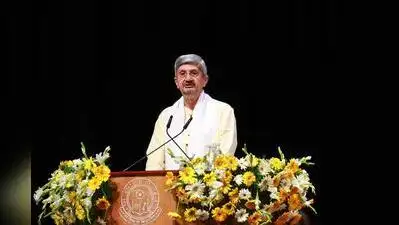
Speaking at the 26th convocation of the University of Hyderabad (UoH), Kamat said, without going into operational details, that sensors, unmanned platforms, secure communications, AI-assisted decision support systems and precision weapons used in the operation were developed by Indian R&D institutions. “It was a declaration of India’s ability to stand tall,” he said, describing the operation as a call to the next generation “to keep the momentum going”. “There is no magic formula for success,” he said, but those who pursue something they are passionate about and enjoy are “highly likely” to excel. “Necessity drives and collaboration delivers,” he said. Because of the lessons learnt, he said, “we are one of the leading countries when it comes to missiles in the world”. His advice: “Stay the course, especially when you have opted for a challenging goal. ” Noting that DRDO’s centre of excellence at UoH grew out of the ACREHEM (Advanced Centre of Research in High Energy Materials) centre set up in 2005, he said the university was one of the key pillars for achieving a Viksit Bharat by 2047. He told graduates not to fear failure, since “you learn more from your failures than from your successes”, and urged those in the humanities and social sciences to see their role as equally critical.
He named the Akash missile system, BrahMos , the D4 anti-drone system and the Netra airborne early warning aircraft. He returned to India and joined the Defence Metallurgical Research Laboratory (DMRL) in Hyderabad, later leading the lab and then the organisation. He illustrated the point with the story of rare-earth magnets. A joint team of the atomic energy department, DMRL and ARCI extracted rare earths from India’s beach sands, and within three years, the full cycle was achieved. A plant in Visakhapatnam now makes the magnets. Of the five missiles taken up in parallel, Agni and Prithvi were developed within five years, Akash and Nag followed, and Trishul was short-closed.
Hyderabad: The success of Operation Sindoor rested not only on the courage of soldiers but also on the technological backbone that supported them, said former Defence Research and Development Organisation ( DRDO ) chairman Samir V Kamat on Thursday.
You Can Also Check: Gold Rate in Hyderabad | Silver Rate in Hyderabad | Bank Holidays in Hyderabad | Public Holidays in Hyderabad | Hyderabad AQI | Weather in Hyderabad | Petrol Price in Hyderabad | Diesel Price in Hyderabad | CNG Price in Hyderabad | LPG Price in Hyderabad Stay updated with the latest Hyderabad news. Download the TOI App.