
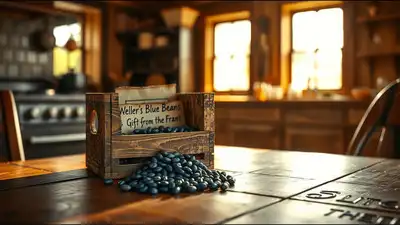
Representative Image of the journey of Weller’s Blue bean from a WWII gift to a heritage collection (AI Generated Image)
A handful of bean seeds given to a family in France in 1946 has survived for decades through careful seed saving. The donor has grown and saved the variety since 1970, and it was among 11 varieties added to the Heritage Seed Library’s National Collection of Heritage Vegetables at the end of 2025. The project began in 2025 as a two-year scheme supported by the National Lottery Heritage Fund.
The dwarf French bean known as Weller’s Blue was given to the father of the current donor by a soldier who had served in France during World War II, according to Garden Organic. The addition was part of Sowing Your Seeds: Heritage Crops for a Resilient Future, a two-year project funded by the National Lottery Heritage Fund that is identifying and conserving heirloom and unusual vegetable varieties being grown across the Midlands. The Heritage Seed Library, run by Garden Organic, collects and conserves varieties in its National Collection of Heritage Vegetables. Through Sowing Your Seeds, the organisation has been searching across the Midlands for unusual and heirloom crops, along with the stories of the people and communities who have grown and saved them.
The donor has subsequently grown and saved the bean since 1970. In 2025, the first 19 varieties from the project were grown on site at Garden Organic’s Heritage Seed Library. Garden Organic says the Gene Bank holds 14,000 samples of vegetable crop seeds for plant breeders and researchers and is expected to contribute 20 varieties over the course of the project for potential addition to the Heritage Seed Library’s living collection. Garden Organic lifted them at the end of the 2025 season and selected the strongest 40 to 50 plants for overwintering before replanting them for a second year. The remaining 11 varieties were successfully added to the Heritage Seed Library’s permanent collection at the end of 2025. Grandfather’s Bean, a broad bean grown by the Burge family in Somerset, has been maintained by the same family for around 150 years. Another accession, Uncle Maurice’s broad bean, has a history spanning 100 years, two continents, three cities and three gardens, according to Garden Organic. Borough Wonder lettuce can be traced to at least a 1945 Burgess Seeds Limited catalogue, while Golden Purslane was described by the English herbalist John Gerard in his 1597 work Generall Historie of Plantes. Other varieties accessioned in 2025 included Mega cress, the dwarf French bean Sigmacropper, Cheshunt Early Giant lettuce, Tip Top radish and the runner bean Portman. Not every unusual variety that entered the 2025 trials was immediately ready for the permanent collection. Donor Roy Bumpsteed cultivated the characteristic for more than 20 years. The work is continuing into 2026. Garden Organic says 27 new varieties are reaching the sowing phase this year, separate from the 19 varieties grown during the first round in 2025.
Because of poor germination, growth or variability, of the original 19 varieties trialled in 2025, five were rejected. Two others, a beetroot and a carrot, are biennial crops and therefore needed another year of growth. Because the plants had cross-pollinated, the resulting seeds could not be kept reliably. Bumpsteed Black is therefore not one of the 11 varieties added to the collection at the end of 2025. Garden Organic says it is being given another chance and is due to be added in 2026 if the second trial successfully produces the desired all-black crop. The organisation is continuing to invite people in the Midlands to come forward with unusual or heritage vegetable varieties so that seeds maintained in gardens, allotments and families can be researched, trialled and potentially conserved for the future.
The organisation says it selects seeds that are not commercially available and have a proven record of performing well from seed to seed in the Midlands. Garden Organic describes it as a dwarf French bean and says its name comes from the donor’s father, who received the seeds from a soldier who had served in France during WWII. Garden Organic says the varieties were checked for germination, vigour and susceptibility to pests and disease, while the horticultural team recorded their characteristics to assess whether they were strong, successful, unique to the collection and consistent across the plants grown. Garden Organic says the varieties are at risk of extinction and will be conserved and eventually shared with Heritage Seed Library members to grow. Garden Organic says the donor’s father named it after his own great-grandfather, who was born in the 1830s. Garden Organic says Portman has been grown by the donor’s family since the 1960s, with the current donor growing it since the 1970s. Garden Organic says the variety was originally a naturally occurring genetic variation, or “sport”, of a commercial bean that produced all-black seeds. Garden Organic says it is the first variety in the Heritage Seed Library collection known to produce two distinct types of seed on the same plant.
Before a variety is grown as part of the Heritage Seed Library’s trials, Garden Organic researches its origins, including speaking with donors and searching historical seed catalogues. This helps distinguish varieties that could add something valuable to the living collection from those already readily available through commercial seed suppliers. Weller’s Blue was one of the varieties that made it through that process. Ten were supplied by the UK Vegetable Gene Bank at Warwick University. The trials involved growing, measuring and monitoring the plants throughout the season. Beans were hand-pollinated with tiny paintbrushes as part of the process. Weller’s Blue was among a group of varieties with unusually long histories. Runner bean Bumpsteed Black is one example. some produced the traditional purple and black-speckled seeds as well as the all-black ones Although the plants grew vigorously during the trial. Instead, Garden Organic’s horticultural team traced the vines of the all-black plants back to their roots and protected the roots so the characteristic could be regrown the following year. Red orach, meanwhile, was successfully added to the permanent collection. The larger brown seeds have thinner coats, while the smaller black seeds have thicker coats. Their different dormancy levels stagger germination, which Garden Organic suggests could help the plant survive under different conditions. You use AI every day. Now get your AI Quotient. Take the AIQ test.