
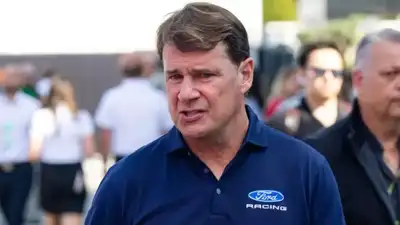
Speaking during a backstage media roundtable at Ford Pro Accelerate, Farley emphasised that AI would increasingly function as a ‘companion’ for workers in factories, repair shows and skilled-trades occupations instead of a replacement, according to a report by Fortune. “I think most of these jobs will be both using AI and also protected from it,” Farley said. “If you work in finance doing spreadsheets, or you’re in a call centre, or you’re an entry-level programmer, those jobs are definitely going to be changed and eliminated with at least this first inning of AI.”
Ford CEO Jim Farley has made a clear distinction between the types of jobs artificial intelligence is likely to replace and the ones that will remain dependent on human expertise, arguing that skilled trades workers will largely be protected from the first wave of AI disruption. However, he warned that more routine white-collar roles face greater disruption.
The automaker employs more than 10,000 skilled-trades workers, representing roughly 20% of its 56,000 UAW-represented workforce.
Electricians, technicians, mechanics and factory skilled-trades workers will continue to be needed even as automation becomes more advanced, he said. These roles will increasingly involve working alongside AI-powered systems, robots and automation tools, but humans will still be responsible for diagnosing failures, applying practical knowledge and ensuring work is completed safely, according to Farley. Farley said technological advances are making it increasingly difficult to distinguish between engineering roles and skilled trades positions inside modern factories.
Farley argued that AI is likely to struggle to replace workers whose jobs require hands-on problem-solving, physical expertise and real-world judgement. At Ford, the shift is already underway. Many of these workers now spend less time maintaining traditional mechanical equipment and more time working with robots, automated production systems and digital manufacturing technologies.
“If they don’t trust that the data’s going to be used the right way, somehow against them or somehow in a not-so-nice way, it’s going to be a problem,” he said. Ford already uses AI-powered vision systems to help inspect vehicle components and improve manufacturing quality. However, Farley stressed that companies must ensure workers trust how data generated by those systems is used. You use AI every day. Now get your AI Quotient. Take the AIQ test.
Farley said he doesn’t see today’s AI-driven efficiency tools as fundamentally different from that earlier tension between management’s view of a system as an efficiency tool and workers’ instinct to see it as surveillance or a threat to their livelihood — suggesting that managing trust, not just deploying the technology itself, will determine how smoothly AI integrates into skilled-trades work going forward.
The company currently employs more than 10,000 skilled-trades workers, representing roughly 20% of its 56,000 UAW workforce.
“The visible line now, it’s kind of hard to tell when an engineer or a manufacturing engineer stops, and the skilled trade starts in these newer type operations,” he said. Farley said this shift is already visible on Ford’s own factory floors. In newer Ford plants, skilled-trades employees may maintain robotic casting systems, troubleshoot battery manufacturing equipment or configure digital production processes. Some tasks, Farley noted, increasingly resemble work performed in semiconductor manufacturing facilities rather than traditional automotive factories. Increasingly, that work is moving beyond traditional maintenance of conveyors and mechanical systems toward repairing robots, handling fiber optic systems, maintaining automated equipment, and operating within increasingly digitized manufacturing environments. He noted that the boundary between skilled trades and engineering has become genuinely blurry inside Ford’s newer manufacturing operations, where skilled-trades workers now maintain large robotic casting systems, configure digital manufacturing processes, and troubleshoot equipment used in battery production — work Farley compared more closely to semiconductor fabrication than to a traditional auto plant. Despite the productivity benefits, Farley acknowledged that workers may be sceptical if they believe AI tools are being used for surveillance or could threaten their jobs. Farley framed the current anxiety around AI in manufacturing as a modern version of a much older dynamic: the historical skepticism workers have shown toward time-and-motion studies, an industrial management practice built around timing workers’ tasks to identify efficiency improvements. He recalled a personal experience early in his career conducting time-and-motion studies, when a worker several years older than him confronted him during a break after noticing he was being timed, directly accusing him of trying to take his job.