
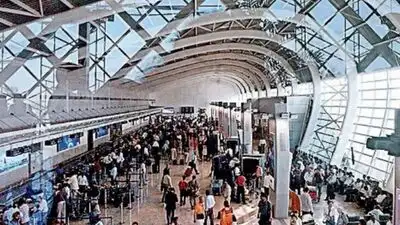
MIAL said the redevelopment is being carried out in phases to minimise the impact on airline operations and passenger convenience.
MUMBAI: Chatrapati Shivaji Maharaj International Airport’s Terminal 1 (T1) is set to shut by the end of October as part of a major redevelopment plan, with demolition of its north section scheduled to begin on January 15, 2027. Akasa Air has already shifted its domestic operations from T1 to T2 from August 1 as part of the operational realignment.
MIAL said the redevelopment is being carried out in phases to minimise the impact on airline operations and passenger convenience. The airport operator said it would provide transition assistance to airlines for around three-and-a-half months before demolition work begins. MIAL has also said it is engaging with domestic and international airlines over the partial movement of flights from T2 to NMIA and from T1 to T2. MIAL has said the phased approach is intended to ensure minimal disruption to airline operations and passenger convenience.
Currently, all flights landing at Mumbai airport use the single operational runway before passengers are taken to either T1 or T2. The shift means passengers will need to check their terminal and airport carefully before travelling. A flight that currently operates from Mumbai airport could eventually operate from T2 or NMIA as airlines redistribute their operations.
The closure will trigger a phased redistribution of flights between Mumbai’s Terminal 2 (T2) and Navi Mumbai International Airport (NMIA). According to a letter written by MIAL chief airport officer Vishnu Mohan Jha to civil aviation secretary Samir Kumar Sinha on August 13, the airport operator plans to begin demolition of the north section of Terminal 1-B from January 15, 2027. At least one-third of all international air traffic movements are planned to shift to NMIA from October 1. From October 25, at least one-third of all air traffic movements at T1 will be moved to T2. This winter, around one-fifth of the 55 million passengers currently handled by Mumbai airport are expected to use Navi Mumbai airport. Of the 15 million passengers handled by T1 at Santacruz East, flights carrying around 10 million passengers are likely to shift to NMIA by the end of October. To handle the additional traffic, the capacity of Mumbai T2 is expected to increase from 40 million to 45 million passengers. Why is Mumbai airport Terminal 1 being redeveloped? T1 is nearly 80 years old, and some parts of the terminal have already been demolished. Mumbai airport’s T1 and T2 currently have passenger-handling capacities of around 15 million and 40 million passengers respectively. The redevelopment is being undertaken in phases, with the first phase involving demolition of the north section of Terminal 1-B from January 15, 2027. Navi Mumbai airport’s Terminal 1 has a declared passenger-handling capacity of 20 million passengers per annum, or around 55,000 passengers a day. However, the terminal is expected to reach saturation point by mid-2026. Navi Mumbai T2, which has a declared capacity of 30 million passengers per annum, is expected to be ready by 2029. Between 2026 and 2029, Mumbai T2 and Navi Mumbai T1 are expected to be expanded beyond their declared capacities to accommodate passenger traffic growth. The airport operator has sought greater coordination between airlines, airport authorities and the civil aviation ministry during the transition, with the aim of reducing inconvenience as the redevelopment of Mumbai’s nearly 80-year-old T1 gets underway.
You Can Also Check: Gold Rate in Mumbai | Silver Rate in Mumbai | Bank Holidays in Mumbai | Public Holidays in Mumbai | Mumbai AQI | Weather in Mumbai | Petrol Price in Mumbai | Diesel Price in Mumbai | CNG Price in Mumbai | LPG Price in Mumbai Stay updated with the latest Mumbai news. As the shutdown approaches, the shift is expected to have a direct impact on flyers and commuters across the Mumbai Metropolitan Region, with passengers travelling to NMIA likely to face longer road journeys and potentially higher travel costs, while the redistribution is also expected to ease congestion at Mumbai airport. The shift is also drawing concern over the additional time and travel costs for passengers who may have to travel to Navi Mumbai for their flights. Longer road journeys could add to the pressure on Mumbai’s already busy roads, particularly for passengers travelling between Mumbai and Navi Mumbai. Mumbai airport T1 shutdown: What is changing Mumbai International Airport Ltd (MIAL), which operates Chhatrapati Shivaji Maharaj International Airport, has begun the process of redistributing air traffic between Mumbai’s T2 and NMIA. Which flights will move to Navi Mumbai? The redistribution will result in a significant movement of passengers from Mumbai airport to NMIA. The remaining five million passengers are expected to be accommodated at Mumbai airport’s T2 in Sahar. How will the T1 shutdown affect flyers? For passengers whose flights shift to NMIA, the biggest change will be the location of the airport they need to reach. Passengers travelling from Mumbai to Navi Mumbai will have to factor in additional road travel while planning their journey. The shift could also mean higher commuting costs for some passengers, depending on their starting point and mode of transport. The increased movement of passengers between Mumbai and Navi Mumbai could also put additional pressure on road traffic. Longer travel times could become a consideration for flyers, particularly during peak traffic hours. MIAL has requested the civil aviation ministry to set up a joint transition group chaired by the civil aviation secretary to coordinate with key stakeholders and minimise inconvenience to passengers. What will happen to Mumbai airport traffic? The redistribution of flights is also expected to ease congestion at Mumbai airport. With part of the traffic shifting to NMIA, congestion at Mumbai airport is expected to ease this winter. This could reduce the holding time for aircraft waiting to land and the time spent waiting to begin pushback for departures. The reduction in congestion is expected to improve the airport’s punctuality and on-time performance. Most general aviation flights, including private and charter aircraft, are also expected to transition to NMIA in the coming months. How much traffic will Navi Mumbai airport handle? Mumbai T1 closure: What commuters need to know For passengers shifted to NMIA, the airport’s location in Navi Mumbai means planning for the additional road journey will be important. The transition could affect both travel time and commuting expenses for flyers travelling from Mumbai. At the same time, the redistribution is expected to reduce congestion at Mumbai airport and improve aircraft movement and punctuality. Download the TOI App.