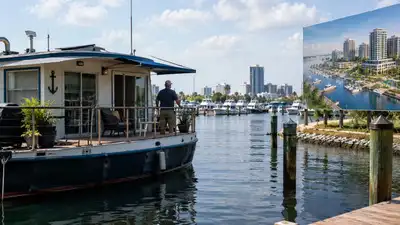
Representative image of a floating-home resident aboard his houseboat as a proposed waterfront redevelopment threatens the marina community. Image Credits: ChatGPT.
In 2006, a small floating home in Riviera Beach, Florida, became central to a larger fight over land, redevelopment and local government power. Fane Lozman had moved his houseboat into the city-owned marina when he discovered that Riviera Beach was planning a $2.4 billion waterfront redevelopment project. The proposal called for acquiring about 2,200 homes and businesses, along with the marina, through eminent domain and transferring the properties to a private developer. The dispute eventually reached the US Supreme Court, which ruled in 2013 that Lozman’s floating home was not a vessel under federal maritime law.
Because the home lacked features associated with maritime transport and was designed as a residence, the court ruled in Lozman’s favour.
Lozman became an outspoken opponent of the redevelopment plan and challenged the city’s actions surrounding the proposed project, according to the University of Miami Law Review . The legal significance of the case extended beyond the unusual appearance of Lozman’s home, according to the Florida Law Review . The justices said the key question was whether a reasonable observer would see the structure as designed to a practical degree to transport people or things over water. The decision established a “reasonable observer” test for determining vessel status, though later cases raised questions about how consistently it could be applied.
Lozman objected publicly to the plan and challenged how the city approved its agreement with the developer. Within months, the redevelopment scheme was abandoned. It developed into a series of court battles that eventually took Lozman and his unusual home to the US Supreme Court.
It was a 60-by-12-foot two-story wooden home consisting of a kitchen, bathroom, bedroom, and office space. The dispute also drew academic attention. The city later filed a separate federal suit arguing that the floating home was a vessel subject to federal admiralty law. The floating home reaches the Supreme Court
As the University of Miami Law Review notes, the redevelopment controversy came before the dispute over Lozman’s floating home and formed part of the background to his ongoing conflict with Riviera Beach.