
Pune was selected for the pilot under the Union govt’s Integrated Disease Surveillance Programme and Pradhan Mantri Ayushman Bharat Health Infrastructure Mission
Dr Vaishali Jadhav, assistant medical officer and in charge of Pune Municipal Corporation’s (PMC) metropolitan surveillance unit (MSU), said, “The project is particularly significant at a time when Pune continues to witness a seasonal rise in fever, diarrhoeal illnesses, and other communicable diseases. Three sentinel sites have been chosen for the pilot project, and this sentinel-site model will enable the civic health department to identify unusual disease patterns and respond more rapidly. The pilot will also combine molecular and serological testing to improve the detection of multiple pathogens.”
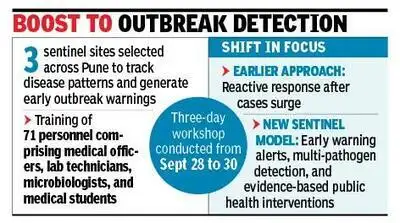
Dr Jadhav added that a three-day training workshop was conducted from Sept 28 to 30 for 71 healthcare personnel, including medical officers, laboratory technicians, microbiologists, and medical students. Pune was selected for the pilot under the Union govt’s Integrated Disease Surveillance Programme (IDSP) and Pradhan Mantri Ayushman Bharat Health Infrastructure Mission (PM-ABHIM). The initiative is being coordinated through the civic body’s MSU. Under the project, three sentinel sites in the city will track cases and generate early warning signals. The sessions covered disease surveillance protocols, laboratory workflows, and digital reporting mechanisms. Experts from the National Centre for Disease Control (NCDC), the US Centers for Disease Control and Prevention (CDC), the World Health Organisation (WHO), Indian Council of Medical Research (ICMR), and Jhpiego guided the participants. Practical training focused on advanced diagnostic and surveillance tools—such as RT-PCR, rapid diagnostic tests (RDTs), ELISA, BioFire syndromic testing—as well as data entry on the Integrated Health Information Platform (IHIP). With the launch of this pilot, PMC officials hope to put the MSU’s epidemiological capabilities to practical use, allowing the city to transition from reactive outbreak containment to proactive, evidence-based public health interventions.