
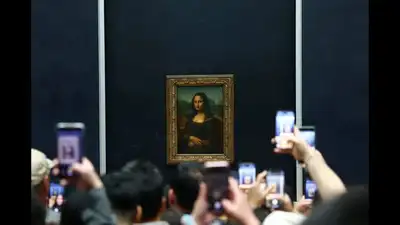
Leonardo da Vinci’s The Mona Lisa became a global icon after being stolen in August, 1911
In August, thieves stole four paintings of over $10 million by impressionist artist Pierre-Auguste Renoir in Southern France. The news comes amid a series of art thefts that have been taking place across Europe since last year, beginning with the infamous Louvre robbery in October, 2025, followed by the stolen paintings from a museum in Italy which were recovered sometime ago, and the robbery of Bronze Age artifacts from a Spanish museum, also in August, 2026. On a solemn Monday morning in August 1911, a thief accompanied by his associates, hurried out of the Louvre carrying a frame. In the first two days after it was rehung in the Salon Carré, more than 100,000 people viewed it,” art historian James Zug wrote for the Smithsonian magazine in June, 2011. By the time the second theft happened, Warhol had reproduced his own version of The Scream, The Scream (After Munch) in 1984, which had attained massive popularity. Like the Mona Lisa, The Scream has also been reproduced and reimagined several times over the years, including by the British cartoonist Peter Brookes in 2017.
Another version of The Scream was also stolen dramatically from the Munch Museum a decade later at gunpoint in “full view of incredulous museum visitors,” according to the museum’s official site. Local artist and sound designer Skooby Laposky has “filled” the empty frame by curating an interactive experience for the people who come to see the Christ in the Storm on the Sea of Galilee via a two-minute audio narrative of a storm hitting the sea, reported WBUR in 2025. Two out of those four paintings have been recovered. But what happens to an artwork after it becomes subject to a theft? The object in question? The Mona Lisa. “Thanks to the high-profile heist, the Mona Lisa became a global icon. The theft made global headlines. However, there was little visual material to go along with the news, so the painting itself became a much used image to report its own disappearance. The artwork was recovered two years later. So by the time of the second theft, the robberies became a noteworthy chapter in the story of a shared cultural icon, reinforcing art critic Paul Richard’s statement — “The Scream can’t be stolen. GARDNER MUSEUM: WHEN ABSENCE BECOMES THE STORY The visitors can now experience the painting through its absence. Eventually, the theft of the artwork acquires a different meaning as years go by, shaping the ways we remember it. Sometimes it is through its absence, and the mystery surrounding it, giving the masterpiece a different kind of afterlife. — Anvita Singh You use AI every day. Now get your AI Quotient. Take the AIQ test Get the latest Lifestyle News and more. Download the TOI app.
However, the 1911 theft changed the scale of that fascination. It featured as a central plot device in the film Glass Onion (2022), was a primary plot catalyst in Dan Brown’s book Da Vinci Code (2003), and was replicated and reimagined by the late artist Andy Warhol in his work, Colored Mona Lisa (1963). In 1994, the theft took place in Norway’s National Gallery on the opening day of the Lillehammer Winter Olympics. The crime was reportedly committed in 50 seconds, with the thieves leaving a note for the museum saying, “Many thanks for the poor security. Regarded as the largest art theft in history, the 1990 theft from the Isabella Stewart Gardner Museum of 13 artworks still remains unsolved. The paintings that are now valued at $500 million also include Vermeer’s The Concert and Rembrandt’s only known seascape, Christ in the Storm on the Sea of Galilee. Speaking about Rembrandt’s missing seascape, the museum’s director of conservation, Holly Salmon told the website WBUR in March 2025, “It is one of the most famous and notorious frames in the world for being an empty one.
Because of what it doesn’t hold.”, but it is iconic in its own right. Before Vincenzo Peruggia was arrested, many were suspected and pursued, including the painter Pablo Picasso. All the brouhaha added to the intrigue. After its return to the Louvre, the painting drew a massive crowd, among which was the novelist Franz Kafka, who was living in Paris those days. This kind of exposure has made it difficult to extrapolate the work of art on its own merit from what it has become over time — an incredibly enduring piece of popular culture. THE SCREAM: BECOMING A PART OF THE LORE Called one of the most recognisable works of art in the Western world, The Scream by artist Edvard Munch was stolen twice. Sometimes, the art does not have to be recovered to be experienced and remembered. The Isabella museum still keeps the gilded empty frames, both as a reminder of the theft, and in the hope that one day they may return to their original home.
Since then, the Mona Lisa has been endlessly represented in popular culture.
Over time, these stolen artifacts acquire more interest among the public as they continue to make headlines. The speculation and prolonged investigation into the incidents can add another layer to its lore, influencing how they are remembered by people — giving an artwork a new level of intrigue, or making a lesser known one become more popular. THE MONA LISA: THE THEFT THAT MADE IT BIGGER Veteran correspondent John Lichfield has described the gentle, knowing smile of the Mona Lisa as “the most visited, most written about, most sung about, most parodied work of art in the world. The da Vinci portrait was already admired within the art circles, with author RA Scotti, writing in his book Vanished Smile: The Mysterious Theft of the Mona Lisa that “there were more than one million artworks in the Louvre collection; she alone received her own mail. Mona Lisa received many love letters.”