
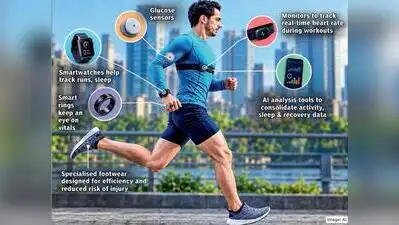
Hyderabad: For a growing tribe of fitness enthusiasts, staying in shape has become serious business. It’s no longer just about buying running shoes or a gym membership. A fitness routine today can run into lakhs of rupees, driven by gadgets like smartwatches, smart rings, specialised footwear, heart-rate monitors, cycling sensors, continuous glucose monitors (CGM), supplements, recovery equipment and app subscriptions.
Around every workout sits an ecosystem of equipment, data, technology and services — and enthusiasts are increasingly willing to spend heavily, with some allocating 20–25% of their annual income to fitness. From running shoes to AI analysis Madeenaguda resident Akhil Chennamaneni, 39, began running about 10 months ago. This excludes the cost of participating in professional events, which can add another ₹1 lakh or more annually. His yearly fitness spend includes more than ₹50,000 on running shoes alone, apart from cycle modifications, a premium gym membership, protein intake and supplements. He consolidates activity, sleep and recovery data, uploads it to cloud storage and uses AI to analyse weekly performance While Akhil’s first tool, his smartphone, helped him track runs digitally, over time, he wanted deeper insights into heart rate, sleep and recovery, leading him to pick up a ₹40,000 smartwatch that collects data throughout the day and during workouts. Divya, 31, who lives in ECIL, was diagnosed with Type-1 diabetes at just seven. Divya’s CGM costs around ₹3,500–₹5,000 every 14 days, adding up to ₹91,000–₹1.3 lakh a year “I spend roughly ₹1.5 lakh per year on fitness, which works out to around ₹12,500–₹13,000 per month. Separately, her CGM costs around ₹3,500–₹5,000 every 14 days, adding up to another ₹91,000–₹1.3 lakh a year. Four years after she began her fitness journey, Divya has completed seven full marathons, two ultramarathons, more than 30 half marathons and several 10K runs. A market running on health, data and upgrades India’s fitness economy, estimated at ₹16,200 crore in 2024, is projected to more than double to ₹37,700 crore by 2030, according to a 2025 report by Deloitte India and the Health & Fitness Association. Cycling, sensors and the pursuit of endurance Krishna Reddy Pulusu, 50, a resident of Manikonda, cycles 40–50 km almost every morning on a cycle worth ₹3 lakh. His cycling computer, speed and cadence sensors and heart-rate monitor cost another ₹54,000–₹60,000, while his running smartwatch cost around ₹1.2 lakh. Krishna allocates at least 10% of his income to fitness but adds that most investments are one-time purchases “I have completed a 200-km endurance ride, and I hope to eventually complete a 1,500 km series of endurance rides. I feel the expensive upgrades are not essential; there are riders who complete long-distance rides on bicycles weighing 18–20 kg,” he says. He allocates at least 10% of his income to fitness but adds that most investments are one-time purchases. Amit Amembal, 56, a long-time technology-enabled yoga mat user, says the AI sensors equipped mat works with a phone app to guide posture, assess balance and stability and rate how well he holds an asana. For Anjith Balmuri, a Kokapet resident who spent about 15 years in Texas before returning to India three years ago, fitness tracking is a 24-hour habit. The device subscription costs him about ₹25,000 a year, while he spends another ₹2,500 annually on a fitness-tracking and social networking app. The wellness technology stack is now expanding beyond conventional fitness trackers with some renowned CXOs also seen sporting compact head-worn devices that track brain activity, while smart rings costing ₹35,000–₹40,000 are being used to monitor sleep, heart rate, body temperature and other health signals.
“I allocate upwards of ₹5 lakh per annum, about 20% of my income, and have built an ecosystem around my fitness routine since,” he says. “Instead of just knowing how I ran, I can now compare one week with another and identify where I need to push,” says Akhil. This includes protein and protein bars, running shoes, fitness watch, gym or fitness membership, race registrations and sportswear,” she says. “I also plan workouts around target pace and pay attention to sleep because I have noticed its effect on my heart rate and performance,” she says. With maintenance, he says, the products last at least a year or two. “It’s the passion,” he says. “I have since moved through three generations of the mat and spent around ₹11,000–₹12,000 on the latest one,” he says. “Time is at a premium,” he says, adding that a guided system at home removes the need to attend a regular class. Sleep, recovery and the ‘always-on’ tracker Somisetty Muralidhar, founder of a firm that makes tech-enabled yoga mats, says consumer behaviour is shifting from fitness to broader wellness. “Walking 10,000 steps is not good enough; they want mental peace too,” he says, adding that rising disposable incomes have changed how people view and buy wellness products. Sleep is a crucial part of any workout, so the band helps me understand my sleep patterns and identify areas where I can improve,” he says. Wellness as discretionary spending Wealth manager Dhaval Parekh says the growing focus on wellness is influencing how people think about discretionary spending. More people are taking up such experiences,” he says. “People are realising that health is the best wealth which is why they are thinking nothing of allocating even around 15–20% of annual income towards fitness and wellbeing,” he adds.
The result is a fitness routine that extends far beyond the hour spent running, cycling, swimming or stretching. What started with a smartphone has since become a full-fledged fitness ecosystem. For Akhil, the most useful part begins after the run. When fitness tech becomes essential Not all fitness spending is about faster timings. For some, technology plays a critical role in safety and disease management. Her fitness kit includes a smartwatch and a CGM sensor. During her runs, glucose readings are transmitted to her watch, helping her track blood sugar levels. The report identifies rising disposable incomes, greater health awareness and technological integration as key forces reshaping the sector. A runner may start with shoes and gradually add a smartwatch, specialised footwear, sensors and recovery tools. A cyclist has an even longer list of potential upgrades, from handlebar-mounted computers to sensors that measure how both the bicycle and the body are performing. The sensors provide real-time information on speed, cadence and heart rate. Yet Krishna offers a reality check: expensive equipment does not automatically translate into better performance. Digital yoga instructor at home Performance is only one part of this shift. As fitness becomes more personalised, technology is also taking on roles traditionally performed by coaches, trainers and instructors. In yoga, the appeal is not just performance but also getting the asanas right without having to leave home. It even corrected his technique in postures such as Bhujangasana, which he had assumed he was doing correctly. For Amit, the biggest advantage is convenience. With companion wearables designed to combine health readings such as heart rate and oxygen levels with yoga practice, for him the technology turns the mat into a digital yoga instructor that can identify what he is doing right and what needs correction. He uses a screen-free health and fitness band to monitor sleep, strain, recovery and other vital metrics. “The goal is to optimise my life further. “If someone is planning to spend on a trip to, say, Dubai, I advise them to consider a wellness or yoga retreat instead as it gives them an opportunity to unplug, focus on wellbeing and return to refreshed. For the new generation of fitness enthusiasts, the pursuit is not just to move more but to know everything about their body. As the data grows, so does the willingness to spend on collecting it.



You Can Also Check: Gold Rate in Hyderabad | Silver Rate in Hyderabad | Bank Holidays in Hyderabad | Public Holidays in Hyderabad | Hyderabad AQI | Weather in Hyderabad | Petrol Price in Hyderabad | Diesel Price in Hyderabad | CNG Price in Hyderabad | LPG Price in Hyderabad Stay updated with the latest Hyderabad news. Download the TOI App.