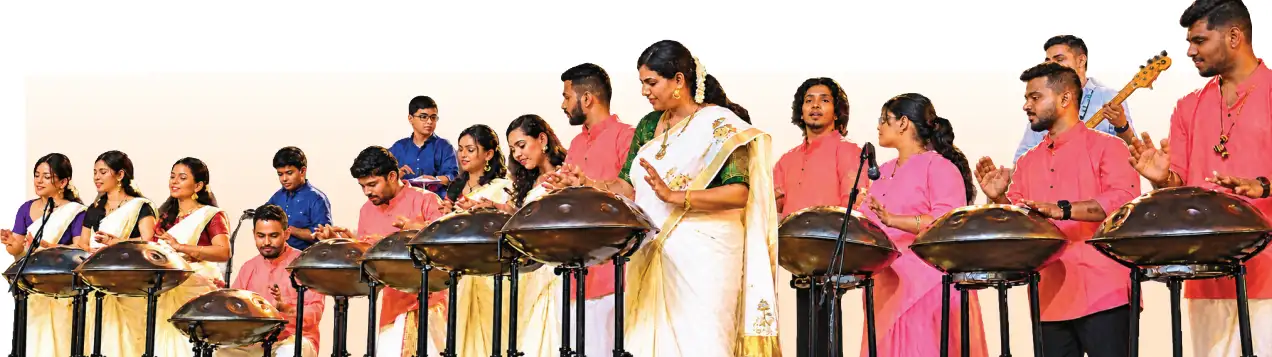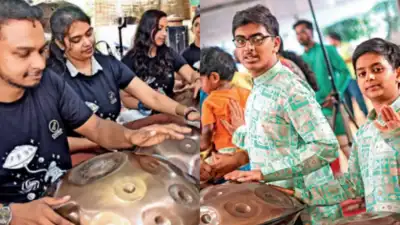
PASSION FOR MUSIC: Ranganathan andSriniketan with their handpans (R) and apractice session of the ensemble
At the centre of the 24-member ensemble were brothers, Ranganathan S, 15, and Sriniketan S, 11. At its debut public performance at Bengaluru’s Ganesha Utsava, the ensemble played five songs with 26 handpans alongside mridangam, ghatam, drums, guitar, synth and djembe. Ranganathan, having completed his Class 10 examinations ahead of schedule, has taken a gap year to focus entirely on music, combining handpan practice with Carnatic vocal training and Vedic studies.
“If it stays in the background, it won’t become famous,” says the teenager. Twenty-six handpans turned a Bengaluru festival stage into a sea of metallic sound. They had spent months rehearsing, travelling across the city several times a week and helping coordinate compositions for the ensemble. Their repertoire included Carnatic compositions along with ‘Varaha Roopam’ from the film ‘Kantara. Led by the Nadamaya Brothers, who were playing two handpans each, the performance offered the city’s growing handpan community an opportunity to demonstrate that an instrument still on the fringes of mainstream music can function as a lead instrument. Their journey began during the pandemic. His ambition is to take Indian handpan music to international audiences and expand its repertoire through Carnatic music, film songs and original compositions. He believes familiarity is key: audiences first recognise a song and then begin paying attention to the instrument producing it. “I want it to become like the flute or the mandolin. ” Origin: Inspired by the steelpan from Trinidad and Tobago, as well as traditional instruments like the Indian ghatam and Indonesian gamelan, people across the world started refining and creating their own versions of handpans. The creators combined elements of the Caribbean steelpan (steel drum) with the Indian ghatam (a clay pot percussion instrument, mostly used in Carnatic music).
PASSION FOR MUSIC Today, both brothers practise for at least two hours every day, often spending considerably longer when preparing for a public performance.