
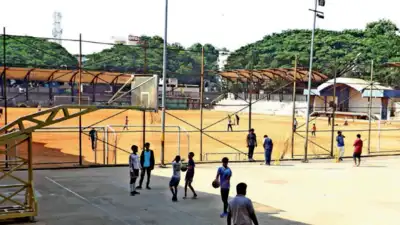
Popular spots: The Malleswaram playground
A Janaagraha survey and study almost a decade ago had said that in Bengaluru, there is only 2.2 square metres of outdoor space available per person, as opposed to the WHO standard of 9 square metres per person. The Urban and Regional Development Plans Formulation and Implementation guidelines from the Union ministry of housing and urban affairs say that for a population of 5,000 people, there must be at least one playground and one park. 46 wards out of the earlier 198 wards have no playgrounds, including in Beniganahalli, Hudi and Kadugodi, according to data hosted in OpenCity.
Because of budget constraints, he says local politicians choose parks over playgrounds.
Also, more than land, it is an access problem,” says urban planner Pravalika Sarvadevabhatla, who works at Jana Urban Space. “We are very dense though, there are a lot more than 5,000 people even in the peripheral areas of the city,” says Pravalika. “parks alone are not enough…kids need to use some playing equipment, be it slides, tyres or spaces where they can jump and move around, cycling paths and trails,” says Pravalika While the likes of Cubbon Park and Lalbagh might make it seem like there are abundant green spaces in the city. “Playgrounds have shrunk into parks,” says Shashi Kumar, general secretary of the Associated Management of Private Schools in Karnataka. Saumil Majumdar, CEO of Sportz Village, says that these spaces get converted into walking parks where you can only walk in one direction, or get engulfed by some kind of construction, or become dumping grounds. Civic activist Arun Pai, GBA brand ambassador for Swaccha Blr, tries to make everyone realise that it might not take a lot to revamp, or “rejuvenate” playgrounds. “If we even just put up things like parallel bars in playgrounds, people would travel kilometres to use it,” he says. Some wanted a cricket pitch, we put up one,” he says. “Bengaluru’s grounds are hungry for citizens’ support,” Arun says.
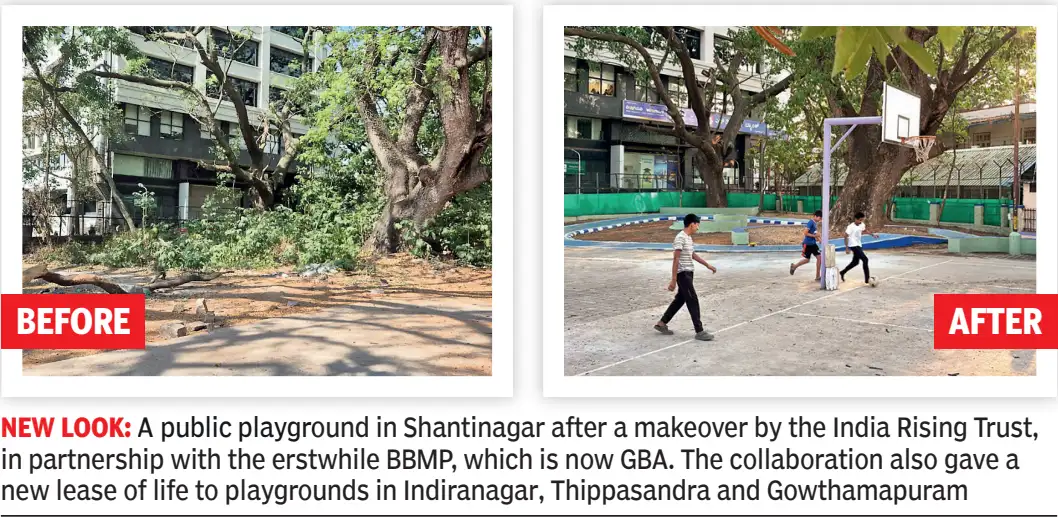
free public playgrounds, the kind that once nurtured future sporting talent, are being left behind While the city expands every day. Here’s what it could take to win those spaces back. Shivaji Park in Mumbai is best known for two things: it is the city’s largest public park, and it is the cradle of Indian cricket, where legends like Sachin Tendulkar and Sunil Gavaskar learnt the game. Bengaluru has its own Shivaji Park stories: Prasanna, Chandrasekhar and G R Vishwanath used to play at National College Grounds, while Syed Kirmani, Brijesh Patel and Roger Binny honed their game at the Central College ground. With concrete taking over the city and playgrounds disappearing over time, children have less space to run around, play, and bicker on basketball courts and football grounds. “The rate at which Bengaluru has grown, has not translated into neighbourhood spaces for playing. New look Global cities have a hierarchy of open spaces, but in India, we are not even close to this hierarchy. Some of the areas with quite a few playgrounds are Rajarajeshwari Nagar and Shanthala Nagar. Often, parks and playgrounds are talked about interchangeably, with people assuming there are abundant spaces to play. A major chunk of the scarcity problem would disappear if the public playgrounds that do exist are maintained well. A frequent complaint among parents is that a lot of the playgrounds are kilometres away from residential colonies and children have to either walk all the way or cycle through unsafe streets with no streetlights; it is not very accessible to senior citizens either. “We ask people what they want. In Shantinagar ground, the kids needed a toilet, so we put up a toilet. “We fight for trees when they’re being cut, but who looks after them otherwise? Or cleaning the garbage dumped near them?” he adds, posing an important question to people.
Today, with lack of space always being an issue in many cities, including Bengaluru, anecdotes like these nearly cease to exist. Many areas in the city today remain with no public playground at all.
By pooling some money, even as little as Rs 10,000, grounds could be made a lot more alive and useful. Around 40%-50% of it lies defunct, under-utilised,” says Pravalika. Bengaluru’s own Freedom Park, opened in 2008–09, turned the old Central Jail campus into a public space with a children’s play area, while preserving several historic prison structures.
This becomes one of the contributing factors to poor physical health, obesity and diseases in girls due to lack of physical activity.
Little steps, he says, like putting up lights, repairing goal posts, setting up basketball courts wherever there is space, can go a long way. pay-to-play courts and sports arenas are good alternatives in cities starved of open spaces, “if you want open access to all, you need playgrounds,” says Arun While turf parks. “Space around our lakes, either littered with garbage or are just unused now, could be utilised for developing playgrounds,” she says. Shashi Kumar says when it comes to big playgrounds, all that the city is left with are those like the Malleswaram playground, MEI ground and others, which are now provisioned mostly for big events. On the other hand, small playgrounds have been disappearing with time, he says. Natesh Kumar, principal of Gurukul International School, which has a very small playground in school premises, says they use BBMP grounds and nearby govt school grounds for big events like annual day and sports day. “We need special cricket grounds, football grounds, even play spaces for women and adolescent girls,” Pravalika says. “We also feel shy to exercise in public, and separate spaces would really help,” she says. There are initiatives to learn from, like “pink parks” that were introduced in Delhi. Emphasising the importance of utilising the limited time and space that is already available, especially when it comes to schools, Saumil says, “Kids don’t seem to have as much problem as the adults, who are more concerned with the amount of space; if the word ‘sports’ is attached to it then it has to be no less than a huge ground.”
“There is no owner of these grounds where kids come to play for free. If some citizens come forward, work with specific playground authorities. When there is an evident lack of something in the market, privatisation is the obvious solution. Land, or the lack of it, is a big problem in India. “But there is a lot of public land available, owned by various govt departments. There’ve been cases across cities where govts unlocked public. “Public land makes up about one-third of the land in Bengaluru. There are such spaces on MG Road and Brigade Road, with own playgrounds that are accessible, but not for the public—why don’t we open up some of them? Pravalika asks. Repurposing certain areas too can increase utility. Arun mentions Delhi govt school grounds being rented out for revenue, post school hours, and thinks Bengaluru would benefit from practising the same. “The smart thing for the govt to do is use available land to generate revenue. This also helps children and sports groups access the space for playing. girls have to worry about safety concerns While boys can unapologetically play in open spaces. Some local areas of the city, like Frazer Town, have designated sections divided for women to work out.
Saumil points out logistical issues: “It’s difficult to execute — by getting 35-40 kids on a bus to a nearby playground, during a class period which is only 35-minutes long, you end up eating into the next period While the Karnataka schools have long been given relaxation from the mandate requiring each school to have their own playground provided they use a public playground or at a reasonable distance. You Can Also Check: Gold Rate in Bengaluru | Silver Rate in Bengaluru | Bank Holidays in Bengaluru | Public Holidays in Bengaluru | Bengaluru AQI | Weather in Bengaluru | Petrol Price in Bengaluru | Diesel Price in Bengaluru | CNG Price in Bengaluru | LPG Price in Bengaluru Stay updated with the latest Bengaluru news.
“Govt schools quite often have more space than private schools, but then there’s the issue of PE (physical education) teachers,” he says, implying that PE teachers and facilitators are very important. He categorises playing into three elements: fitness, skills and match play. “Something that’s true of the Indian cricket team as well, is that most of the action, the playing happens in one corner of the ground—only for the match do you need the entire playground. “If the school is only focusing on forming a good sports team, they’ll only focus on five most talented kids of the lot, ignoring the rest, and then it’ll be like math class all over again. If Bengaluru wants children and adults to keep playing and running around in open grounds, it must be a mixed effort, from people, the authorities and schools alike. Download the TOI App.