
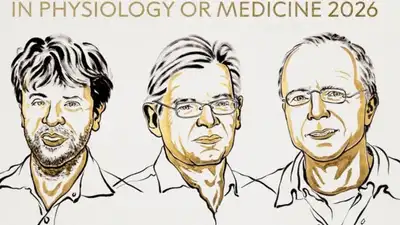
Winner of Nobel Prize in Physiology or medicine (Credit: Mattias Karlén © The Nobel Assembly at Karolinska Institutet)
In 2005, his research group introduced the gene for channelrhodopsin-2 into rat nerve cells grown in the laboratory.
The 2026 Nobel Prize in Physiology or Medicine was awarded on Monday to Karl Deisseroth, Peter Hegemann and Georg Nagel “for their discoveries concerning light-gated ion channels and optogenetics”, a technique that allows scientists to control the activity of nerve cells using light. The Nobel Assembly at Karolinska Institutet said the three scientists had laid “the foundation of a new era in neuroscience”. “Optogenetics provides opportunities for mapping the brain in a way that we could once only dream of,” Per Svenningsson, chair of the Nobel Committee for Physiology or Medicine, said.
Their work has enabled researchers to switch individual nerve cells on or off in living brains, helping them study how neural circuits control memories, feelings and behaviours. Karl Deisseroth later transformed this discovery into a tool for controlling nerve cells. When exposed to blue light, the cells generated nerve signals. The method, which came to be known as optogenetics, has since become a widely used tool in neuroscience. Researchers have used it to identify neural circuits involved in functions including pain, social behaviour, thirst, food consumption, reward and attention, as well as to investigate neurological and psychiatric disorders. The work has also opened possible medical applications. Researchers are studying optogenetic approaches to restore vision in people with severe visual impairment, while the technique is also being investigated as a way to improve the precision of cochlear implants.