
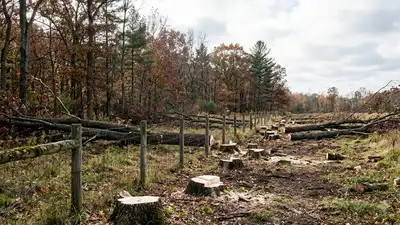
In total, 133 trees on Deal’s property had been felled. (Representational photo)
A Kansas appeals court on Friday, upheld a $6,500 damages award against a man whose fence-building project led to 133 trees being cut on a neighbour’s property in 2015.
The court rejected several challenges raised by accused Douglas H Black, including arguments that the lawsuit was filed too late and that the damages were not properly calculated, according to legal research website Justia.
Neises examined the trees that had been cut and identified 115 post oaks, five hickories, five red oaks, two red cedars, two green ashes, two American elms, one hackberry and one redbud. Using his calculations, Neises valued the damage at $13,799.96. Using Neises’ observations but a different method of calculation, Church placed the value of the downed trees at $61,497.61. In August 2025, it ruled that Wade had trespassed onto Deal’s property when trees were cut well beyond the fence line. The court awarded Deal $6,500.
Because it formed part of the Cross Timbers ecosystem and described work he had carried out to improve wildlife habitat, including removing invasive species, he said he bought the property. Because Wade was found to be Douglas’ agent, the court held Douglas responsible for the damage. Because of a last-minute trial continuance requested by Deal’s lawyer, it also reduced that amount by $400 to account for attorney fees Douglas had incurred.
Deal told the court that the property had personal and biological importance to him. He has a degree in Fisheries and Wildlife biology and had worked as a public lands regional supervisor. Both sides brought experts to court to discuss the value of the damaged trees. Deal hired consulting forester Ryan Neises. Deal also hired forest ecologist and conservation consultant Kevin Church. The district court did not accept either of the experts’ figures as the final amount.
Deal then filed a lawsuit against Douglas in December 2017, alleging trespass and seeking damages for the destroyed trees. There were several delays and continuances, including some connected to the Covid-19 pandemic, settlement discussions and problems involving the lawyers. A bench trial was eventually held in October 2024.
Douglas challenged the case on several grounds, including the argument that Deal had waited too long to sue. The case did not reach trial quickly.