
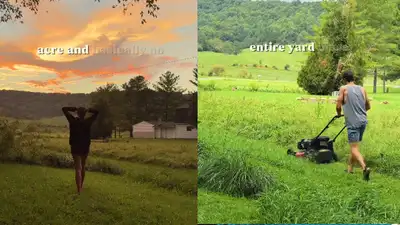
Photos: @brittany.lafave/ Instagram
Lafave, who is 27 years old, told PEOPLE, “Our goal is to take the things we all love about State Parks and recreate them on a tiny scale at home. The couple has spent nearly $500 to $600 over six months, according to PEOPLE. That includes a discounted display-model lawn mower from Lowe’s for $200, instead of the $450 retail price. It also includes about $150 on tools, $100 on string and landscaping lights, an $80 clearance picnic bench, and $50 on flowers. They then put another $300 into the produce garden to cover it with fencing to keep deer out, which brings the total to about $900. She treats each addition as a small project, most costing under about $150, and sometimes spreads one over a few weeks. In the garden beds, she buys one native flower each week, usually around $10, and after she planted the first one this year, a butterfly arrived within 24 hours and a hummingbird a few days later.
Because she doesn’t want a yard she has to fight to keep alive, she added that native plants suit the local climate, so many need far less watering and care, which is quite important.
They decided to build a miniature “state park” instead. Building a bench from material taken straight from the land feels fitting, since benches are a staple of state parks, according to Lafave. Lafave told PEOPLE they haven’t set an overall budget. Instead of laying walkways, they let sections of the yard grow wild and mowed trails through the middle, this creates “edge habitat,” where open ground meets taller plants, so rabbits, chipmunks, groundhogs, and birds get food, cover, and room to move. Lafave said plants she never planted showed up on their own, including cardinal flowers, goldenrods, and asters. Followers on TikTok have also helped, she said, by sharing tips on native plants and habitat.
Gardens are our soothing retreats where we plant our green pals and take good care of them by regularly cleaning, pruning, and trimming the plants and grass. But taking care of a huge garden is one of those tasks that requires quite a bit of effort, as we water it, feed it, trim it, and sometimes quietly stress about it. But maybe the places where many of us feel happiest are best kept when they are rarely that tidy. One such example is set by a couple who moved into their Virginia home and decided to transform their backyard into a forest retreat without much hassle of keeping the edges of the grass neat and tidy. When Brittany Lafave and Ryan Webb moved into their first home in Virginia last winter, their one-acre yard was overgrown, but instead of making it soil and span, they chose not to clear it for a regular lawn. After nearly six months, the yard grew winding trails, meadow-like patches and native gardens, and shares her progress on social media. The idea grew out of the couple’s love of hiking in the Blue Ridge Mountains. They also found that they already had a lot to work with. The yard came with mature trees, garden beds, and old materials. A concrete pad buried underground became the focal point, and a dead tree is planned as a DIY bench. ID@undefined Caption not available. The money side is the surprising part. That made her see the project as bigger than their own acre. She explained that many small yards can act like stepping stones that help reconnect broken habitats. You use AI every day. Now get your AI Quotient. Take the AIQ test Get the latest Lifestyle News and more. Download the TOI app.