
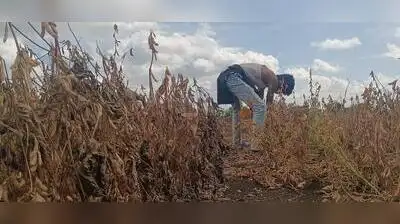
Withered soybean crop in Washi tehsil of Dharashiv district
Under Maharashtra Groundwater (Development and Management) Act, 2009, the administration has moved to prevent new wells from coming up within 500 metres of a notified public water source. “We have only 2 TMC water left in our lakes. Dharashiv resident Ashok Chavan, from Kalamb tehsil, said tankers have been supplying his area since March, every 15 days. The district’s rainfall was within tolerable levels through June and July (123.9mm compared to 126.9mm and 136.9mm against a normal of 137.1mm, respectively). But the monsoon virtually collapsed in August — only 43.1mm against a normal 154.4mm, a deficit of nearly 72%. Field inspections found that available moisture in the root zone had fallen below 25% across the district, placing it in the severe category under the state’s drought assessment framework.
Now, we have to somehow protect our drinking water sources so that people have supply for the next few months,” said Dharashiv district collector Keerthi Kiran Pujar. “Simply issuing restrictions won’t suffice. You Can Also Check: Gold Rate in Pune | Silver Rate in Pune | Bank Holidays in Pune | Public Holidays in Pune | Petrol Price in Pune | Diesel Price in Pune | CNG Price in Pune | LPG Price in Pune Stay updated with the latest Pune news.
Officials said the powers were being invoked to stop desperate villagers from digging wells and borewells. If the natural spring that feeds the pump is hampered by a borewell, it can dry up that pump,” a senior official from the revenue department told TOI . The official acknowledged enforcement would be a “major challenge” as it’s nearly impossible to know if borewells are being dug in remote villages. “So, residents in these remote parts will have to work with local officials to ensure public sources of water are protected,” the official said. Experts said groundwater during a drought often becomes the “last dependable buffer” for rural communities as surface reservoirs, streams and farm ponds dry up. If groundwater extraction around a community source continues unchecked, individual users with deeper or more powerful borewells can effectively suck out an aquifer that feeds a public source,” a groundwater-management expert told TOI . Another water-management expert said accurate mapping of drinking-water sources, monitoring of borewells and regular groundwater assessments are necessary. The administration must identify recharge and influence zones of each critical source and prevent fresh extraction before the source fails,” said the expert, who has been working in Marathwada for the last few years.
Pune: District administration in drought-hit Dharashiv, where groundwater levels have fallen by more than nine metres in some areas, has now invoked special powers to protect public sources of drinking water from overuse and extraction. Sections of the Act also allow authorities to regulate extraction, including temporary closure of all wells within a kilometre of a natural source. All eight tehsils of Dharashiv district have been declared drought-hit. “If they hit a natural spring, it can cut off supply to a public drinking water source. For instance, one hand pump caters to one hamlet. But there are gaps. “During such distress, priority has to be drinking water. Download the TOI App.