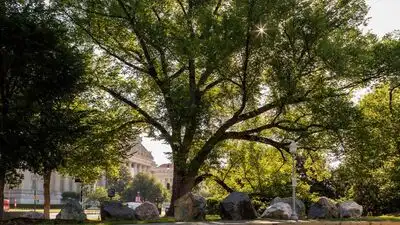
The Smithsonian Witness Elm, thought to be roughly 170 years old, bursts into greenery each spring. Image Credit: Smithsonian Gardens
A historic American elm on the grounds of the Smithsonian National Museum of Natural History in Washington, D.C., has survived for more than 150 years, quietly witnessing generations of American history. Planted around 1850, the Smithsonian Witness Elm was already established decades before the museum opened in 1910. Since then, it has seen 33 US presidents, major national events and sweeping changes to the city around it. The Smithsonian Gardens document states that the fungus was introduced to the United States around 1930 and went on to kill millions of American elms throughout the country. Dutch elm disease was first identified in the Netherlands in 1919 and detected in the United States in 1930. The disease reached Washington, D.C., in 1947.
Because dutch elm disease later killed millions of American elms across the country, leaving this tree as a living reminder of a once-common part of the American landscape, its survival is especially remarkable. Because cities had planted so many elms, the loss was especially significant. The survival of the Witness Elm becomes more remarkable when set against the history of Dutch elm disease. Smithsonian Magazine provides more detail on the disease’s impact. It is caused by a fungus that is commonly spread by European elm bark beetles. Once inside a tree, the fungus blocks the tissues that carry water and nutrients, causing leaves and branches to die. By the 1970s, the US Forest Service estimated that tens of millions of American elms had been killed. The Smithsonian Witness Elm is not believed to possess the strong resistance to Dutch elm disease found in some other American elms. The Witness Elm also receives preventative treatment. Smithsonian Magazine reports that the tree is injected with fungicide every three years to help protect it from Dutch elm disease.
Smithsonian arborist Jake Hendee explained to Smithsonian Magazine that many large, old elms that remain today may simply have survived through a combination of chance and careful management.