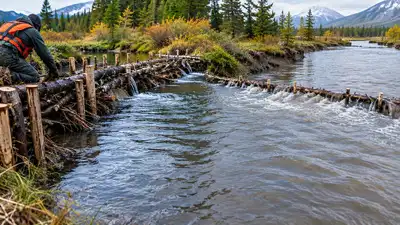
Representative image of a worker installing a log-based stream restoration structure in a mountainous river landscape. Image Credits: ChatGPT.
Wooden stakes measuring 3 to 6 inches in diameter were driven into the streambed, and branches were woven between them. By 2017, the beavers were doing more than just colonising the restored section. The structures at Myers Creek were simple. Some structures were built across the streambed to slow the flow and retain sediment. Other structures served as deflection structures where the flow would be diverted towards the sides of the streambed, encouraging the channel to meander. The goal is not simply to create a series of ponds. Sediments could be retained through reducing the power of flowing water in the stream. The channel rose and reconnected with its natural floodplain. These beavers had constructed a dam at a site where weaving was not completed and had also contributed to the construction of another BDA. The beavers had even constructed a pioneer dam below the last structure installed. This was close to the project’s goal: using man-made structures to restore a degraded stream and encourage beavers and plant life to return.
The structures were installed along about 1,900 feet of Myers Creek as part of the Triple Creek restoration project, according to the Washington State Department of Ecology . The project included 14 planting sites and protection for other plants to help regenerate a riparian plant community that could restore shade, stability and food sources for returning beavers. At Myers Creek, the 26 structures also interacted with the spring 2017 floodwaters, helping redirect flows, widen the incised channel and encourage sediment deposition instead of allowing the water to keep cutting through the channel.
The restoration team therefore turned to what are known as Beaver Dam Analogues, or BDAs.
Both natural beaver dams and beaver dam analogues can alter stream-channel conditions by slowing water, retaining sediment and influencing channel shape, according to research published in River Research and Applications . The creek had been badly altered by a major rain-on-snow event in the 1990s, which sent unusually large flows through the channel, deepened it and left steep banks while draining parts of the surrounding wetlands. When the beaver ponds that had once helped hold the floodplain in place disappeared, the drier ground also became more favourable to invasive plants. They were intended to recreate some of the physical effects of natural beaver dams and, importantly, encourage beavers to return and eventually maintain the system themselves. The Washington Department of Ecology also notes that the restoration team planted native vegetation and tackled reed canarygrass, an invasive plant that had become widespread after the creek became drier. However, there is one crucial difference between a natural beaver dam and a BDA. Unlike a natural beaver dam, a BDA cannot repair itself. The study found that these structures could promote sediment accumulation and modify local channel geomorphology, although their performance could vary during high-flow events.