
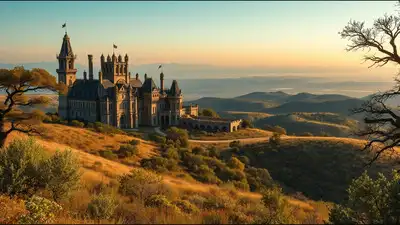
Representative Image of a majestic Texas castle inspired by Ludwig II’s unrealized plans, surrounded by scenic Hill Country landscapes (AI Generated Image)
Falkenstein Castle in Burnet sits on 110 acres and contains a roughly 14,000-square-foot stone residence with seven bedrooms, six tiny homes and an additional apartment above a maintenance garage. The property is currently listed for $9 million, after first being offered for $15 million in May 2025 and going through a series of price reductions. The castle was built by Texas businessman Terry Young and his wife, Kim, after a 1995 trip to Germany’s Neuschwanstein Castle.
Drawings for another castle planned by Ludwig II inspired them to build their own version in Texas, according to the couple’s own account of the project. A castle inspired by the unrealised plans of Bavarian King Ludwig II is on the market in the Texas Hill Country. Young has since died, and press reports say the property was passed to the couple’s son, who decided to put it on the market.
At $9 million, the asking price works out to roughly $643 per square foot based on the 14,000-square-foot figure in the property listing, before accounting for the 110 acres, six tiny homes and an additional apartment. In July 2025, UNESCO inscribed The Palaces of King Ludwig II of Bavaria: Neuschwanstein, Linderhof, Schachen and Herrenchiemsee on the World Heritage List. The 110-acre property is now being offered for $9 million, giving the unfinished 19th-century vision a modern Texas chapter.
Neuschwanstein is therefore now part of a four-site UNESCO property associated with Ludwig II. The sale follows the death of Terry Young. Press reports say the property was passed down to the Youngs’ son, who subsequently decided to sell it. That gives the current listing a different context from the castle’s original construction: the property that began as the couple’s response to a German architectural idea is now being offered to a new owner. There is also a recent historical connection to the story. Falkenstein, the separate castle he planned but never built, is not part of that UNESCO inscription. The Texas Falkenstein stands apart from those historic Bavarian palaces. It was built more than a century after Ludwig II’s death, on a hilltop in Burnet rather than in Bavaria, but its design traces back to the plans for a castle that the Bavarian king never got to build. You use AI every day. Now get your AI Quotient. Take the AIQ test.
The story began in 1995, when the Youngs travelled to Germany and visited Neuschwanstein Castle. The Bavarian Palace Administration records that the foundation stone for Neuschwanstein was laid on September 5, 1869, after work on the site had begun the previous year. The castle remained unfinished when Ludwig II died in 1886. Historical accounts identify Christian Jank as the artist behind an 1883 design, while later designs for the site were also produced. Highsmith in 2014 for her archive at the Library of Congress describe Falkenstein Castle as a residence built from scratch by Kim and Terry Young in the hills below Burnet. Current property listings describe the estate as approximately 14,000 square feet on 110 acres, with seven bedrooms, four full bathrooms and four half bathrooms. The MLS records 1998 as the year built. The Library of Congress archive’s 2014 photographs provide a contemporary record of the completed Texas property. The property was initially offered for $15 million in May 2025. It was subsequently reduced to $14 million and later to $9 million. The exact dates of the reductions have been reported differently across property coverage, so the safest figure to use is the current $9 million asking price and the documented $15 million starting price rather than presenting an uncertain day-by-day price history.
Falkenstein therefore remained a project on paper, rather than one of Ludwig II’s completed residences.
They noticed drawings in a gallery at Neuschwanstein that did not appear to depict the castle they had just toured, according to the Youngs’ account of their trip. After asking about them, they were told they related to another project Ludwig II had planned, Falkenstein. The couple’s account says they later travelled to Lechbruck, Germany, to meet Wilhelm Kienberger, a former Neuschwanstein director who had the drawings, and that Kienberger made copies of Christian Jank’s rendering of the planned Falkenstein along with other sketches.
A later Texas Hill Country article retells the same account of the Youngs’ discovery of the drawings, their meeting with Kienberger and their decision to build a Texas castle inspired by the plans. The historical basis for the story is that Ludwig II really did plan a Falkenstein castle near Pfronten in Bavaria. The project was never built, although work connected with the planned site had progressed by the mid-1880s. The Texas project eventually became a substantial estate. Photographs taken by Carol M. Her captions also record the use of large quantities of limestone, granite, sand, cement, rock and block in the buildings and note that the castle was sometimes opened for weddings. The grounds include six tiny homes and an apartment above a maintenance garage. The listing also describes hilltop views of the Highland Lakes and presents the property as a residence, event venue or investment property. The Texas castle is not a reconstruction of an existing medieval German building. It is a modern residence whose design was inspired by Ludwig II’s planned Falkenstein project and the Youngs’ experience visiting Neuschwanstein. The property’s asking price has changed substantially since it first went on the market.