
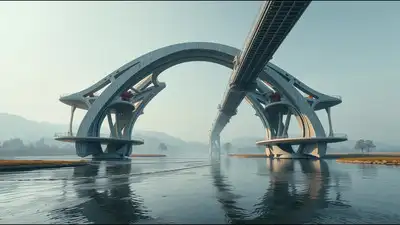
Representative Image of a modern bridge inspired by Leonardo da Vinci and built with 3D printing technology ( AI Generrated Image)
Da Vinci’s Bridge: how 3D printing brings Leonardo’s design into the modern era
A bridge inspired by a design sketched by Leonardo da Vinci more than 500 years ago has been brought to life as a modern prototype using 3D printing and waste from stone processing. The prototype is a pedestrian bridge with a span of approximately 6 metres and adapts Leonardo’s concept for the needs of the experiment. B&Y, an Italian start-up led by Vincenzo Gurrado, developed a low-environmental-impact mortar made from 30% waste stone and marble powders combined with a lime-based binder. Instead, Fallacara’s team adapted the concept into a roughly 6-metre pedestrian prototype, allowing the researchers to test the combination of 3D printing, stone-processing waste and the geometric principles behind Leonardo’s design. Leonardo’s original design relied on the arrangement of individual elements to create a self-supporting form, and the modern prototype applies the same underlying principle to its 13 3D-printed blocks. When the project was reported in January 2025, the team said its next steps included evaluating the material’s mechanical properties and refining the printing process.
WASP and the Polytechnic University of Bari said, the project team describes Da Vinci’s Bridge as the first 3D-printed bridge to use waste materials from stone processing , combining additive manufacturing with Leonardo’s original vision for a self-supporting structure. The project’s distinctive feature is not simply that the bridge was 3D-printed, but that its construction material incorporates waste from stone and marble processing. The project brought together the ArCoD department of the Polytechnic University of Bari with WASP, which supplied the 3D-printing technology, and B&Y, which developed the material. Leonardo’s original bridge was never built, but its design was notable for its self-supporting form. The modern project does not reproduce the proposed structure at its original scale. The use of stereotomy is key to the bridge’s structure. The temporary centring system was used during assembly, but the finished bridge does not depend on those temporary supports to remain standing. The project demonstrates how waste generated during stone processing can be incorporated into a material for 3D-printed construction rather than being treated solely as a disposal problem.
The project was conceived by Professor Giuseppe Fallacara of the Polytechnic University of Bari and draws on Leonardo’s design for a bridge that would have connected the Pera district, present-day Galata in Beyoğlu, with Constantinople, today’s Istanbul, across the Golden Horn.