
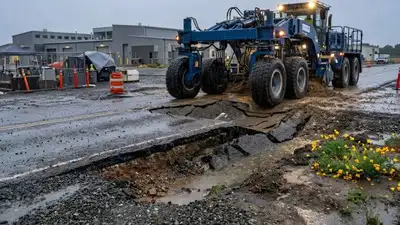
Representative AI image showing a heavy-vehicle simulator testing road pavement durability at an outdoor research facility. Image Credits: Google Gemini.
Because cold recycled asphalt mixtures can have relatively high void content and need protection from water, this matters. A study published in the Journal of Cleaner Production has also found that climate and pavement structure are important factors in the performance of cold central-plant and cold in-place recycled pavements, while these recycling approaches have offered substantial reductions in energy use and greenhouse-gas emissions.
Earlier field and laboratory work has shown that pavement design, climate and the thickness of adjacent layers can strongly influence the performance of cold recycled pavements.
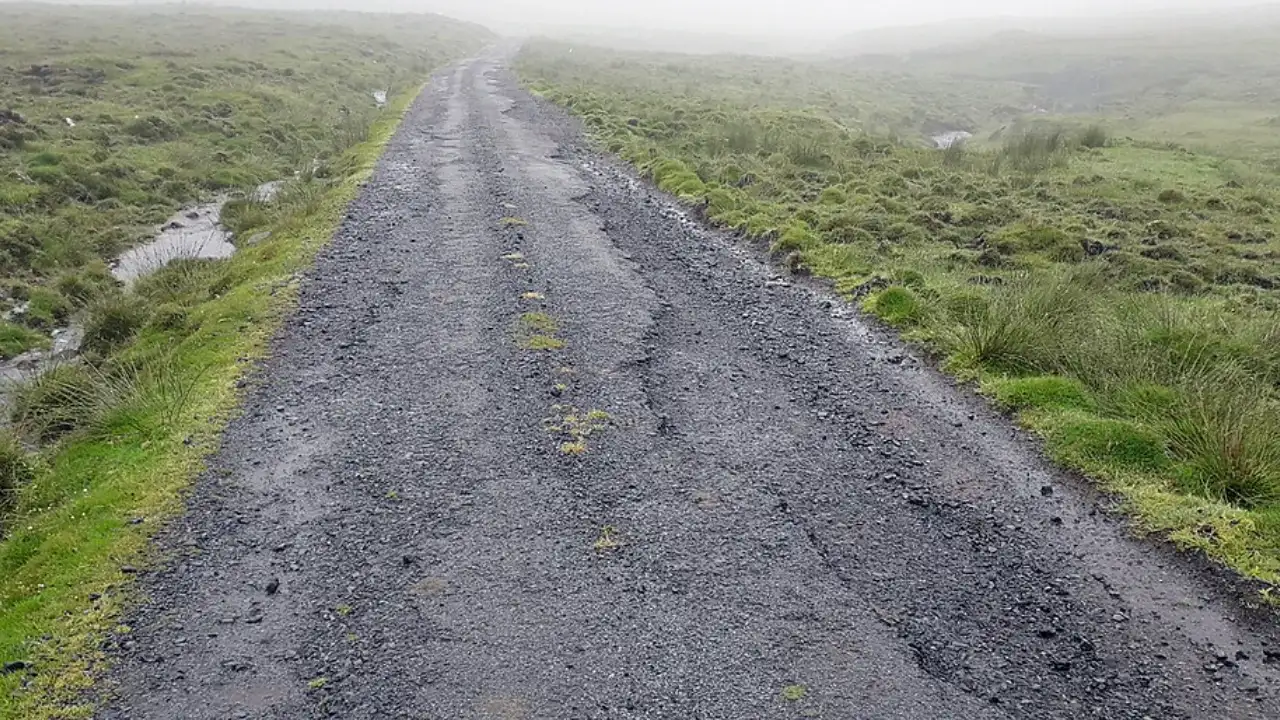
Six tests were carried out on a specially constructed track to examine cold recycled pavement made with 100% recycled asphalt pavement. The researchers tested the sections at two pavement temperatures, about 30°C and 50°C, and under two moisture conditions. Traffic loading continued until a section reached either 12.5 mm of terminal rutting or a specified level of cracking. The number of equivalent single-axle loads needed to reach terminal rutting ranged from about 200,000 to more than 15 million.
A Heavy Vehicle Simulator (HVS) was used to repeatedly load pavement sections with heavy wheels during the experiment, according to the University of California Pavement Research Centre . Properly designed and constructed cold recycled layers can perform well, according to the researchers. The results did not show that the recycled asphalt itself caused the failures. Instead, investigators linked the most serious problems to localised shear failures in the aggregate base after heavy rainfall and to incorrect water contents in part of one recycled layer. Some sections were tested as compacted, while others were exposed to a constant flow of water. The results varied widely. The section that failed at the lowest traffic level was tested at high temperature and already had construction problems with foaming water and mixing moisture. The investigation provided one of the clearest lessons from the experiment. Heavy rainfall caused water to enter the pavement structure, and localised shear failures developed in the aggregate base. Once that underlying layer weakened, repeated heavy loading could cause substantial deformation even if the recycled asphalt layer itself was not the source of the problem. The California experiment ultimately delivered a more useful message than a simple success-or-failure story. But pavements with marginal aggregate bases that are vulnerable to shear failure when wet need extra attention, especially where heavy axle loads and extreme weather are expected.