
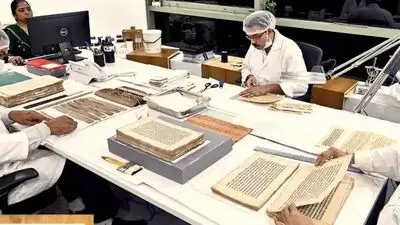
Gyan Bharatam is an initiative to document, preserve, and digitise a large number of manuscripts in India.
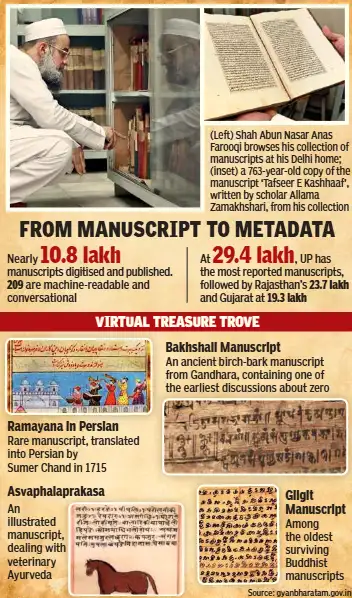
Ambika Pandit follows the effort to conserve and digitise them and checks out how easy it will be to read them In the lanes behind Delhi’s Turkman Gate, Shah Abun Nasar Anas Farooqi and his son Ubada guard 579 manuscripts in Arabic, Persian and Urdu. The family says the paper manuscripts are 100 to 800 years old. A 2025 study on ancient Devanagari, for instance, identified the scarcity of good transcribed training data as a major obstacle to handwritten-text recognition.
From family shelves to temples and libraries, more than a crore manuscripts have been reported to Gyan Bharatam .
“We have to be very careful, and sometimes keep the books out in sunlight to prevent decay,” says Ubada, 30, a postgraduate in Arabic and Islamic studies. BharatiyaGPT’s “Talk to Manuscript” layer promises text, audio and voice-based interaction; the project’s AI interface invites users to “Read, Listen & Talk to Manuscripts with AI”. Scholars come looking for rare nuskhas (manuscripts) on Islamic studies and Sufism. Handling the fragile books is under the family’s watch. The project faces challenges related to technology and the physical condition of the manuscripts. Technology is intended to shorten the process. Gyan Mitram — an AI-powered knowledge interface integrated in Gyan Bharatam — uses optical character recognition, handwritten-text recognition, script recognition, semantic search and machine-assisted translation. Pandulipi Darpan is designed to take an image of a manuscript and attempt script recognition, transliteration and translation. The technology needs to be tested. Handwritten documents can be difficult for recognition systems: old forms of scripts may have little high-quality transcribed material for systems to learn from, while faded ink, damaged pages and variations in handwriting add challenges.
Who gets access?
Gyan Bharatam project director Anirban Dash said, as of Sept, the portal had given more than 1,000 people access to manuscripts. Digital copies are now available for viewing for 15 days; the mission will extend that period to a month. In Jamshedpur, 21-year-old BBA student Ashutosh Jha registered two Maithili manuscripts written in Tirhuta, or Mithilakshar, that he inherited after his father’s death. In Saboo village near Leh, ex-serviceman Richen Tundup has reported 21 manuscripts in Tibetan script. Gyan Bharatam was much needed, he says, recalling how manuscripts were lost during the 1984 riots at Delhi’s Gurdwara Rakab Ganj. He has reported 25 digitised manuscripts in Devanagari and Gurmukhi. A three-month survey was launched on March 16. Of nearly 2.3 crore submissions, around 1.3 crore have qualified as reported manuscripts. By the latest count, nearly 10.8 lakh manuscripts belonging to 129 custodians have been digitised and published on the portal for public viewing; around 209 are machine-readable and conversational. An Aug report by the parliamentary panel on transport, tourism and culture noted that the govt aims to digitise one crore manuscripts in five years, with a target of 20 lakh by March 31, 2027. By Sept, the mission had onboarded 51 cluster and independent centres, including Jamia Hamdard, the Bhandarkar Oriental Research Institute, Sampurnanand Sanskrit Vishwavidyalaya in Varanasi and the Central Institute of Buddhist Studies in Leh. The National Mission for Manuscripts, established in 2003, conducted state surveys that reached homes, temples, madrasas and other repositories. Its National Database of Manuscripts produced metadata for 52 lakh titles, against 3.3 lakh manuscripts digitised by Jan 2025; 76,000 were open for public viewing, according to the culture ministry’s response in the recent parliamentary panel report. Three days after the survey began, the govt said data on nearly 13 lakh manuscripts had been reported.
Because the team must seek permission from custodians, approvals take one to two days. But the gap between a manuscript being reported and becoming safely usable remains substantial. You Can Also Check: Gold Rate in Delhi | Silver Rate in Delhi | Bank Holidays in Delhi | Public Holidays in Delhi | Delhi AQI | Weather in Delhi | Petrol Price in Delhi | Diesel Price in Delhi | CNG Price in Delhi | LPG Price in Delhi Stay updated with the latest Delhi news.
“We want the creation of the manuscripts repository under Gyan Bharatam to be a people’s movement,” says culture secretary Vivek Aggarwal. The govt says digitised copies will be made available according to the rights of custodians and rights-holders, with restricted material subject to access conditions. Dash said a framework had been prepared to reduce delays. “I felt it was my responsibility to preserve what my family had protected for generations,” he says. In Payyanur, Kerala, folklorist V Jayarajan says he has spent decades persuading families not to discard old manuscripts. “Many village homes had manuscripts but did not know what to do with them and would dispose of them,” he says. His Folkland centre says it now holds more than three lakh manuscripts on palm leaf, bamboo and paper. Bhai Baldeep Singh, a custodian in Nizamuddin East and a descendant of a long lineage of Gur-Sikh masters of ‘Gurbani Kirtana Maryada’, says this part of cultural heritage did not receive the attention it deserved after Independence. A large number, he says, were reduced to ashes. “These notebooks are an unparalleled source of learning about the nuances of ‘Gurbani Sangeet’,” Singh says. Dash says AI doesn’t yet have all the answers. When a manuscript is damaged, he says, AI tools can only suggest what the text might be; a human will still need to verify it. Govt says Gyan Bharatam’s survey is the biggest yet, and aims to create an interactive central repository.
Until now, the collection’s survival has depended largely on the family’s knowledge of what is on its shelves and its care in deciding who may handle the books. This year, the Farooqis also allowed their manuscripts to be entered in Gyan Bharatam, the Union culture ministry’s effort to map manuscripts across the country — with libraries, institutions, families, temples, monasteries, madrasas, scholars and other private custodians. The mission does not ask the Farooqis to surrender the texts. Participation is voluntary and does not affect ownership or require manuscripts to be transferred. The first step is to collect information about the holder, location and approximate number of manuscripts. Physical verification, detailed cataloguing, conservation and digitisation are meant to follow. That creates a delicate bargain. The govt wants to know what survives in private hands and eventually make more available for research. Custodians may want help identifying, conserving or reading their manuscripts while retaining control. For now, access is time-consuming and limited. In a TOI test in Sept, creating an account triggered an approval process without stating when approval would come. Requesting access to a manuscript required the user to give a reason and wait for another approval. Through designated cluster centres, custodians will be trained to categorise manuscripts as freely accessible, available for a fee or restricted. They will receive login details and be able to classify their own manuscripts. Access matters, especially to people who have inherited manuscripts but cannot read them. He hopes experts will study them. He cannot read them. His family keeps them in the prayer area and brings them out when monks visit. They cover subjects ranging from epics and ayurveda to carpentry, local rituals and village payment systems. Gyan Bharatam’s scale turns the preservation of private collections into a national task. The ministry describes four stages: identifying where manuscripts are held; physically verifying them; cataloguing language, script and subject; and providing conservation support and digitising them. The search continues beyond the survey. “However, the achieved pace, computed from the ministry’s successive official statements, has been of the order of a third of a lakh each month. The pace the targets ask for is of the order of one and a half lakh each month,” it stated. The govt also plans to set up conservation labs and provide equipment and training. A manuscript that’s damp, brittle or damaged by fungus must survive before it can become a clean digital file. That is the problem visible on Farooqi’s shelves. Gyan Bharatam has started sending teams to geotagged locations to verify manuscripts and assess their condition, so it can decide what conservation and digitisation support is needed. The mission is working on tools that can read complexities of letters in languages such as Sanskrit and interpret marginalia. Three months later, the figure was above a crore. Back in Turkman Gate, the physical challenge remains. When the humidity rises, Ubada and his father must still protect paper that has survived longer than anyone now living. Gyan Bharatam can mark the collection on a map and create digital copies. And the manuscripts still must make it through another year. Download the TOI App.
An earlier parliamentary reply also listed controlled access and possible monetisation benefiting custodians among the mission’s objectives. Gyan Bharatam builds on earlier efforts. The earlier mission also described its survey as an effort to create a manuscript map of every district and state.