
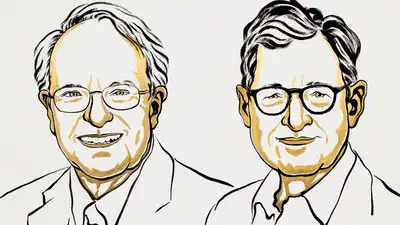
Robert E Hall and Michael Woodford won in the Economic Sciences category for 2026
With them, we are better equipped to deal with shocks in the economy, such as energy crises or sudden changes in how much households consume,” says John Hassler, chair of the Committee for the Prize in Economic Sciences. Instead of relying mainly on broad economic indicators such as inflation, production and consumption, the two economists developed models based on how individual households and businesses make financial decisions. “The laureates’ work has provided us with a stable theoretical foundation for the models that are now used by central banks and governments around the world.
It was instituted in 1968 by Sveriges Riksbank, Sweden’s central bank, to mark its 300th anniversary, and was first awarded in 1969 to Ragnar Frisch and Jan Tinbergen. Amartya Sen won in 1998 for his contributions to welfare economics, and Abhijit Banerjee in 2019, who shared the award with Esther Duflo and Michael Kremer for their experimental approach to alleviating global poverty. Meanwhile, two Indian-born economists have won the prize in this category.
Unlike the other Nobel Prizes, the Economics Prize was not established by Alfred Nobel in his will. Officially known as the Sveriges Riksbank Prize in Economic Sciences in Memory of Alfred Nobel, it is awarded by the Royal Swedish Academy of Sciences under the same principles as the original Nobel Prizes. The prize money is funded by Sweden’s central bank and is equal to that awarded in the other Nobel categories.
Their research helped address the limitations of earlier economic models, particularly those exposed during the oil crises of the 1970s, when high inflation, unemployment and weak growth occurred simultaneously.