
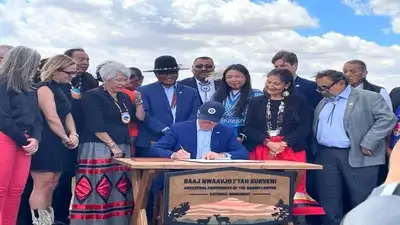
President Biden established the National Monument. The signing event brought together state politicians and tribal community leaders. Credits – Wikipedia
On August 8, 2023, President Joe Biden established the Baaj Nwaavjo I’tah Kukveni–Ancestral Footprints of the Grand Canyon National Monument in northern Arizona. The proclamation designated approximately 917,618 acres of federal land for protection, withdrawing those lands from new mining claims subject to valid existing rights. Because many of the region’s villages depend on groundwater, and the Havasupai rely on springs fed from underground aquifers, water is especially critical.
The Grand Canyon region offers more than dramatic cliffs and desert scenery. It contains ancestral sites, sacred places, traditional food and medicinal plants, and water sources that have sustained Native American tribes for generations. Thus, uranium mining in the region has produced issues that go beyond the mineral business. Those fears evolved into a lengthy discussion over how the federal government should manage public land around the canyon. The designation followed decades of tribal advocacy over the risks of uranium mining and the need to protect culturally significant sites. It put a protective ring around Grand Canyon National Park, but it didn’t stop every mining operation already permitted within the new borders. The tribes that fought uranium mining Uranium deposits, including high-grade ore in geological formations known as breccia pipes, occur throughout the Grand Canyon region. Mining interests have been drawn to these deposits for decades, but the area also has groundwater systems, springs, and streams that feed wildlife and communities throughout northern Arizona. The Havasupai Tribe has been particularly vociferous about what they perceive as the potential effects of uranium mining near Red Butte, a sacred meeting spot near the canyon. The Havasupai have significant cultural and spiritual ties to the water, plants, animals and geology of the area. Other tribes, like the Hopi, Navajo, and Zuni, also consider aspects of the surrounding landscape to be culturally important. Mining issues include the chance that excavation could disturb radioactive materials and other elements, creating paths for toxins to reach water, soil, plants and animals.
A 2024 U.S. How the monument was established The 2023 designation was not the first federal action to prohibit uranium mining near the Grand Canyon. In 2012, the Department of the Interior withdrew more than one million acres of federal land near the Grand Canyon from new mining claims for 20 years, subject to valid existing rights. In August 2023, the national monument established a distinct and more enduring protection framework for 917,618 acres of federal land next to Grand Canyon National Park. Together, these areas cover 917,618 acres of federal land managed jointly by the Bureau of Land Management and the U.S. In 2021, a study of uranium in Grand Canyon groundwater by the U.S. Geological Survey and published in Scientific Reports looked at 573 water samples collected from 180 springs and 26 wells between 1981 and 2020. Of the 206 groundwater sites assessed, 195 (95%) had maximum observed uranium concentrations below the U.S. Environmental Protection Agency’s drinking-water limit of 30 micrograms per liter. At the other 11 sites, maximum concentrations were at or above that limit; four sites recorded concentrations of 100 micrograms per liter or more.
Geological Survey report incorporating the Havasupai Tribe’s perspective warned that published risk models have “largely ignored exposure pathways relevant to Tribal communities. These pathways include inhalation, ingestion and skin contact involving traditional foods, medicinal plants and materials used in ceremonies. The report recommends incorporating Indigenous knowledge into assessments of potential risks to culturally important resources. The judgment authorised further investigation into potential environmental implications, but it maintained existing lawful mining rights. The monument comprises three geographically separate areas northwest, northeast and south of Grand Canyon National Park. Forest Service. Scientific information also helps explain why the use of groundwater has been at the heart of the dispute. These measurements describe observed groundwater conditions and do not, by themselves, establish that mining caused the elevated concentrations. The study set a baseline for what the conditions of the groundwater were, not evidence of mining pollution in every area of the region. This baseline helps scientists distinguish naturally occurring uranium from changes that may be associated with mining activities. The bigger problem is that the dangers differ by location, geology, river movement and mining circumstances. Assessing potential impacts includes water quality monitoring, determining pathways by which toxins migrate through groundwater, and incorporating indigenous knowledge. Cultural concerns also go beyond quantitative contamination to include protection of sacred sites and customary links with the land.
The action did not prohibit all mining or cancel previously established rights.
The previous 20-year withdrawal was grandfathered in, allowing two existing permitted mining activities within monument limits to operate under their current authorisations.
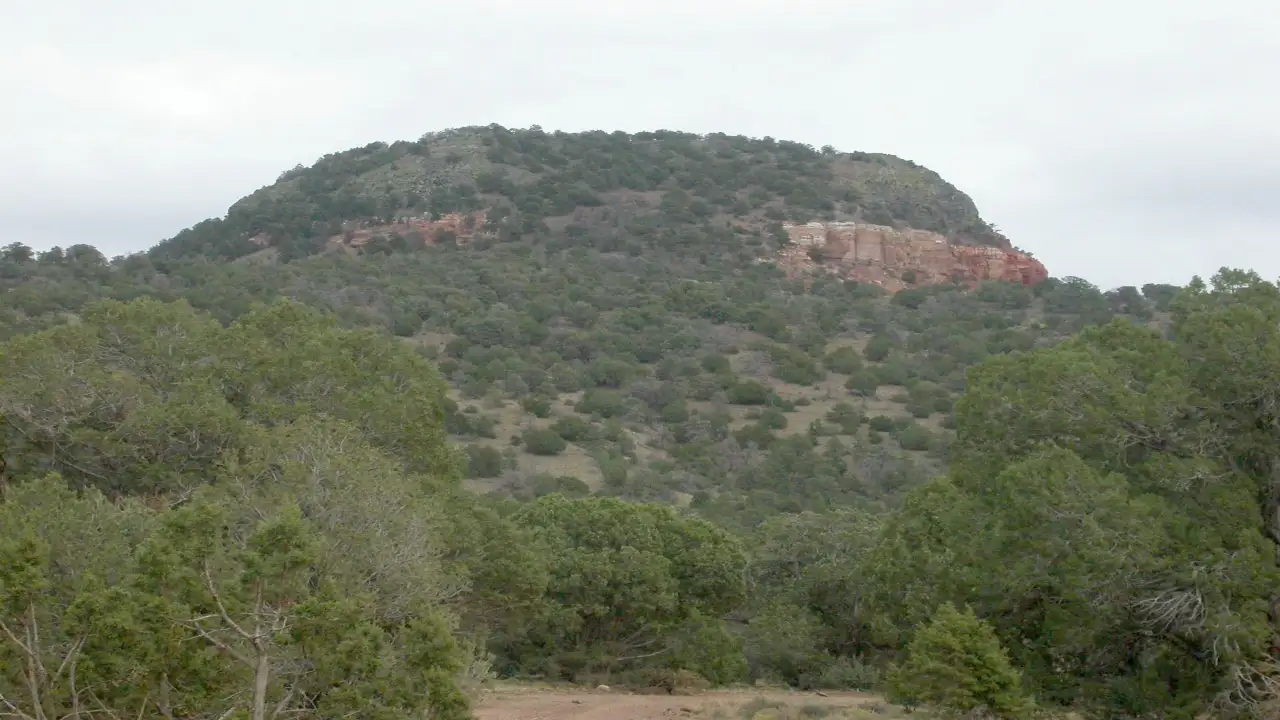
In Havasupai, Baaj Nwaavjo means “where Indigenous peoples roam,” while in Hopi it’s I’tah Kukveni, “our ancestral footprints. It takes its name from two Indigenous languages. The designation was meant to recognize the cultural history of the terrain as well as its ecological, geological and scientific significance. The protected region encompasses thousands of known cultural and historic sites, including places essential for tribal ceremonies and traditional practices. Its habitats are home to mule deer, bighorn sheep, bald eagles and California condors, while streams and subsurface water systems link the landscape to the larger Colorado River basin. The White House fact sheet announcing the monument called the declaration a way to conserve sacred ancestral places, cultural resources, wildlife habitat and clean water. It also directed federal agencies to collaborate with tribes and develop collaborative management arrangements. Image of Red Butte. Credits – Wikipedia What the mining restrictions protect The monument designation significantly restricts the ability for new mining by removing the designated federal lands from the location of new mining claims under the relevant federal standards. It does not, however, put an end to all mining. The proclamation recognizes existing rights that are legitimate. This issue has been fundamental to arguments over uranium mining in the region.
Biden’s 2023 announcement was a massive increase of conservation around the Grand Canyon, putting 917,618 acres of federal land under monument protections. It also codified a reaction to years of lobbying by tribes worried about uranium mining and the future of the region’s water, wildlife and cultural resources. The monument did not address all disputes over existing mining rights. You use AI every day. Now get your AI Quotient. Take the AIQ test.
It created a larger protected landscape but did allow some previously authorized operations to continue, placing long-term management, scientific monitoring and engagement with indigenous nations at the heart of the area’s future.