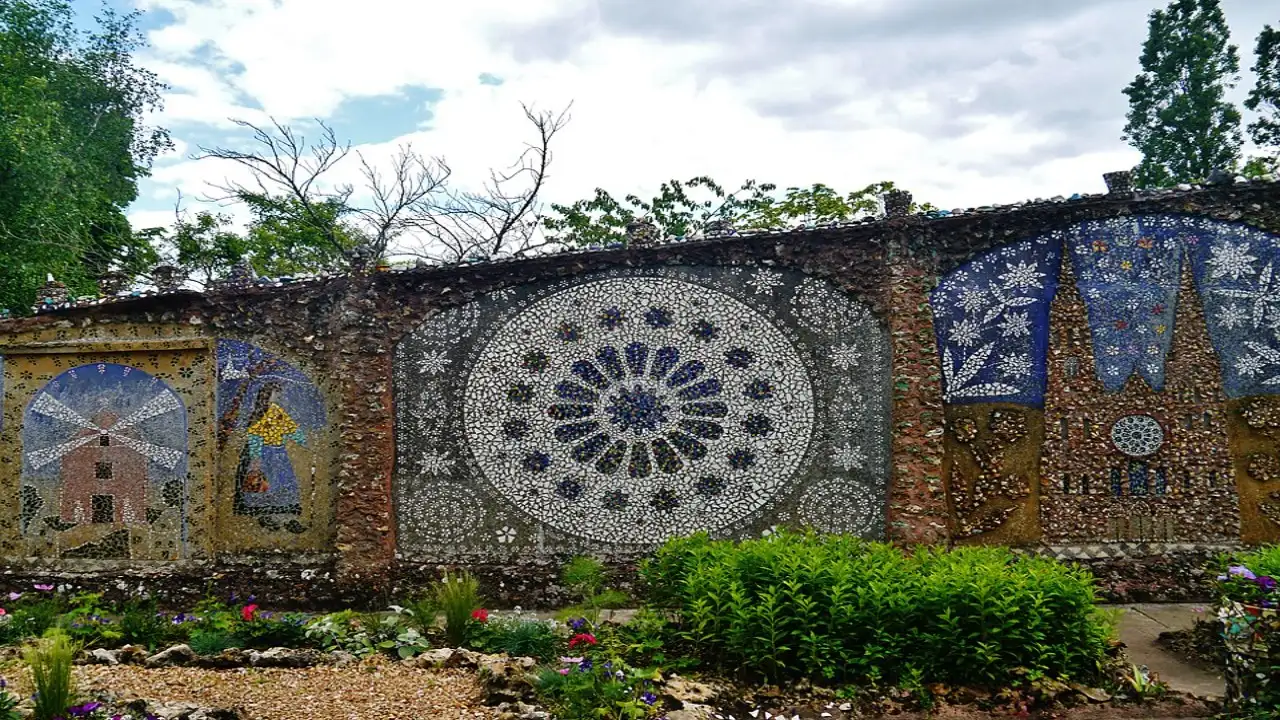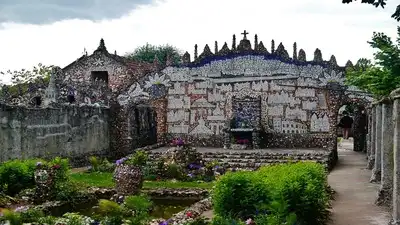
Representative image of Garden of the Picassiette House (Image Credits: Wikimedia Commons)
Isidore was born in Chartres on September 8, 1900, the seventh of eight children in a modest family of the era. He joined the City of Chartres as a road worker in 1935, and later worked as a sweeper at Saint-Chéron cemetery, where he remained until resigning in 1958. Isidore purchased a plot on Rue du Repos in 1929 and built a three-room house with help from his stepsons Michel and Bernard Rolland. That changed when he encountered broken pieces during a walk in 1938 and began collecting, sorting and storing the fragments in his garden. Representative image of Garden of the Picassiette House. (Image Credits: Wikimedia Commons) The project eventually expanded beyond the house itself and by 1945, Isidore had begun decorating the exterior, including an enclosure wall, while later work extended across gates, pathways and the garden. In 1956, he undertook new construction behind the house, including a chapel and summer house, and bought an adjoining plot for further garden decoration.
A cemetery worker spent decades turning a modest home in Chartres into a mosaic environment made out of broken crockery, porcelain and glass, according to the Ville de Chartres. What began with a few pieces collected from fields and rubbish repositories became La Maison Picassiette, now a museum owned by the City of Chartres and recognised as a national Historical Monument. He received a basic education and moved through several jobs, from being a foundry moulder to a railway employee and municipal theatre prop man. It had a kitchen-dining room, a small living room and a bedroom, and decoration was not originally planned. The work expanded across the interior, with the walls, floors and ceilings covered in mosaics. Furniture and everyday objects, including a bed, kitchen table, sewing machine and chair, also became part of the composition. In the painted areas, he added flowers, birds, landscapes and other scenes to surfaces that were not covered with fragments. These spaces allowed his imagery to become more expansive. The chapel is filled with Christian scenes and symbols, including a large cross and a nativity scene, alongside a countryside scene with a woman, shepherd, dog, chickens, rabbits and ploughs. One wall depicts cathedrals and places of worship using black glass and white china; another includes Jerusalem, the Leaning Tower of Pisa and the Colosseum. In addition to the mosaic representations of cities and notable buildings featured in the summer house, Isidore placed a throne at the base of the elaborate exterior composition.