
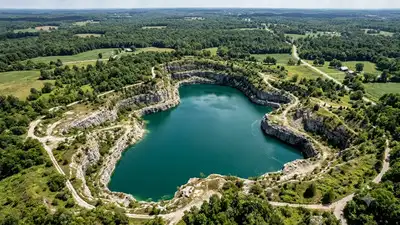
After learning about the proposed sale, the Village of Luckey began considering acquiring the property itself. (AI photo)
Two brothers in Ohio who bought an abandoned, flooded quarry for $330,000 in 2005 and spent 15 years improving it have been caught in a long legal dispute with the village where the property is located. Steve and Tim Snyder had planned to sell the land in 2021, but the Village of Luckey began proceedings to acquire it through eminent domain, a legal power that allows governments to take private property for public use with compensation. However, the legal battle has left Luckey facing approximately $206,000 in legal fees, with a judgment lien now recorded against the village. The amount represents nearly one-third of the village’s general fund balance of approximately $640,000 at the end of 2025, according to a report by The Blade. The case began with a failed property auction in September 2021.
Because the property owners are challenging the settlement agreement reached by their former lawyer, the payment has not yet been made. The brothers alleged that village officials had discouraged potential buyers from bidding, while Luckey maintained that it wanted the quarry as a possible public water source. The disagreement eventually reached the United States Court of Appeals for the Sixth Circuit, where the brothers’ federal constitutional claims were dismissed.
The dispute continued for nearly five years before the village abandoned its attempt to acquire the property in April this year.
Steve and Tim Snyder purchased the inactive quarry and surrounding land in March 2005 through their company, T&S Agriventures LLC. They paid $330,000 for the property, intending to improve it for future development or sale. Over the following 15 years, they worked on the land’s topography and grading, cleared vegetation, established electricity and sanitary sewer services, and maintained the quarry lake. In July 2021, the brothers hired Beth Rose Real Estate and Auctions LLC to market the property. An auction was scheduled for September 18, with a reserve price to prevent the land from selling below an agreed amount. In August 2021, the village council unanimously authorised its attorney to begin the eminent domain process. The village continued pursuing the land and, in September 2022, offered the brothers $525,000. In February 2024, a federal district court dismissed their claims. It noted that the brothers still owned the land and that the $610,000 auction bid demonstrated the property had not lost all economic value. Luckey continued its attempt to acquire the quarry until April 2026, when the village council formally abandoned the eminent domain proceedings. The decision led to a settlement involving legal fees, with a $206,000 judgment lien recorded against the village in the Wood County Court of Common Pleas. The village’s payment was due on August 15, but Mayor Mike McNulty said officials were waiting for the court to resolve the dispute over the settlement. Luckey, a village of approximately 1,000 residents, ended 2025 with $640,217 in its general fund, according to financial statements cited by The Blade. Its annual revenue was approximately $1.16 million.
Because the highest offer was below the reserve price, after bidding closed at $610,000, the property remained unsold. Because it prevents further claims against individual village officials and limits recovery to legal fees rather than additional damages, the family is seeking to reverse the agreement. The potential legal payment is therefore a substantial expense for the village.
Days before the auction, village officials told the brothers that any purchase offer would depend on laboratory results assessing the quarry’s water. The auction company later contacted registered bidders, several of whom said the village’s actions had influenced their decision not to bid, according to the court documents. “The village is able to operate functionally,” he told The Blade.
Their aim was to make the property suitable for residential or other development. However, after learning about the proposed sale, the Village of Luckey began considering acquiring the property itself. Officials initially identified a public water supply or park as possible uses, before later specifying water supply alone. They also indicated that the eminent domain process could take several years. On the auction day, the village placed temporary ‘No parking; signs on nearby public streets. Its representatives attended the event but did not bid. The brothers alleged that the officials’ presence discouraged buyers. The dispute subsequently moved into court. The Snyders and their auctioneer filed a federal lawsuit alleging violations of constitutional protections concerning private property, equal treatment and due process. The Sixth Circuit Court of Appeals subsequently upheld that decision. The majority ruled that the village’s announcement of its intention to acquire the property did not itself amount to an unconstitutional taking. However, Circuit Judge Eric Clay disagreed in a dissenting opinion. He argued that the brothers had presented sufficient allegations of deliberate interference with the auction to allow their takings claim to proceed. The majority also acknowledged concerns about aspects of the village’s conduct but concluded that the allegations did not establish a constitutional violation. However, the settlement remains disputed. Steve Snyder alleged in court documents that the family’s former attorney, Zachary Murry, agreed to the settlement in July without consulting them. Nevertheless, McNulty maintained that essential services, including streets, sewer operations and other everyday functions, were not at risk. “We’re not going to be able to go and build a swimming pool or something like that. The everyday function of the village, streets, sewer, things like that- the village is fine. You use AI every day. Now get your AI Quotient. Take the AIQ test.