Image: Left/Christie’s/Right/Canva
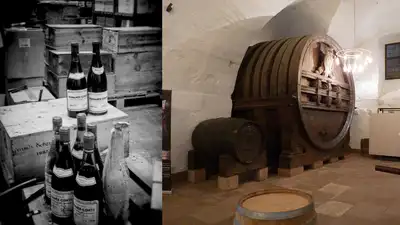
In 2021, an out-of-the-blue telephone call from a couple who no longer really drank reached Noah May, head of Christie’s Wine and Spirits department in London. May told Christie’s, in a story, about the auction house in May 2026 that the owner, who was in her eighties, worried about perishing labels and dusty conditions, and warned him not to get too excited. It led to what he counts among his greatest discoveries. The bottles sat in a former air-raid shelter in southern England, reachable only through a thick hedge at the end of a garden. Her caution was understandable, since nobody could say what decades underground had done to the collection.
There were cases of Krug champagne from 1955, and Quinta do Noval port from 1931, along with various vintages of Domaine de la Romanée-Conti, La Tâche and Grands-Echézeaux. Then came eight bottles of Mouton Rothschild 1945, a wine May described to Christie’s as arguably the greatest Bordeaux ever made. The collection was then offered in London in December 2021 under the title Treasures from a Rediscovered Chalk Cellar, a name that promised a story as much as a sale. Its luxury category, which spans jewellery, handbags and accessories, watches, and wine and spirits, was the main entry point for new buyers in 2025 and achieved a combined total of $795 million, according to Christie’s.
His reaction was immediate; May said he felt like “a poker player holding a royal flush. May told Christie’s that it took a long time to bring everything up to the surface, and even longer to convince the owner that the stained labels were not really an issue. Rahul Kadakia, head of Global Luxury, told Christie’s that its varied, relevant selection keeps drawing newer, younger buyers, particularly in luxury sales and among clients in the Asia-Pacific region. Christie’s says prospective clients can request a complimentary estimate, provided the property meets the minimum consignment value, by telephone, Instagram, in person or through its online estimate service.
As May descended the staircase, the torchlight on his phone picked out one treasure after another. Stained labels, the very thing the owner had worried about, hinted at age rather than ruin. The moment shows why the discovery mattered so much. Champagne, port, Burgundy and claret of this calibre sat together in one forgotten room, untouched for decades. Finding the wine was only the beginning. In fact, he explained, the cellar had provided perfect conditions for storing wine. That was welcome news for an owner who had expected disappointment. What looked like neglect turned out to be an unexpectedly good home for wine, and the shelter had protected the bottles for decades. Patience, in other words, was as important as expertise. May’s discovery sits within a wider story. If a forgotten cellar behind a hedge can hold more than three and a half million pounds of wine, it may be worth looking at what sits in your own attic.