
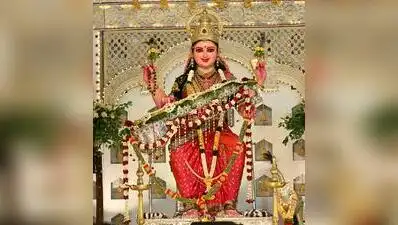
Goddess Sharada idol at Kudroli Sri Gokarnanatha Temple in Mangaluru created by Kubera Shivamogga.
Later, using hay, we build up the basic shapes — the structures based on how each deity should look, whether with four, eight, or 10 hands.
Kubera said that the task of creating and giving a final touch to each idol requires utmost dedication and deep concentration. After that, alongside daily prayers and spiritual disciplines, as the forms of those idols emerge, we craft them according to the devotional essence and postures suited to each deity. Following that, we apply finishing clay to shape the faces and hands, smooth out the areas that need a refined finish, and then the painting process begins,” said Kubera, who uses only organic materials for his work. On time management while handling work across three locations in Mangaluru, Uchila and Udupi at a time, he said that the team proceeds with the work — stage by stage. “When it comes to the finishing work, I oversee and assist at each location to get them ready,” said Kubera, who is making idols for Mangaluru Dasara for the ninth year, for the fifth year in Uchila, and the second year in Udupi.
Mangaluru: Behind the beautiful faces and expressive eyes of Goddess Sharada idols installed at three major temples along coastal Karnataka is an artist whose skilled hands transform clay into divine forms. As Dasara celebrations gather momentum in Mangaluru, Uchila and Udupi, Kubera Shivamogga is the man behind the idols adding to the festival’s spiritual fervour. “Physical labour assistants can do the work, but the artistic perspective requires spiritual discipline. We begin all the work only after performing the Peetha Puja (consecration ritual of the base). For the Sharada idol, we perform the Peetha Puja on the day of the Ganesha festival and commence work,” he explained. “We work step-by-step simultaneously for all the idols. First, we prepare all the armatures. After that, we mix paddy husk and river clay together to the right consistency, apply the clay, and sculpt the shapes of the idols. “Once the structural work is completed at one place, we move to the next location to do the structural work, and then to the third location.
“I seek the blessings of Sri Siddalinga Mahaswami of Gonibeedu, Shivamogga, before commencing the work,” he said.
Kubera, who has a workshop, Sri Guru Kalamandira, in Shivamogga, earlier used to work with his master BJ Rajashekhar to make idols at temples.