
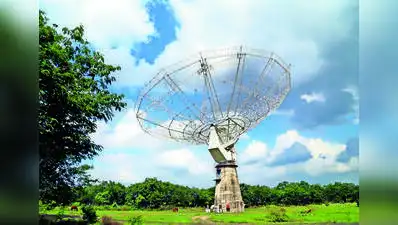
The GMRT, near Pune, was designed nearly four decades ago to detect the hydrogen signal from galaxies in the early Universe
Nissim Kanekar, another co-author and faculty member at NCRA-TIFR, said the detection was an important step towards measuring the hydrogen signal from individual galaxies from that period — something astronomers have not yet achieved. The team is carrying out deeper observations of the same region using the GMRT in an attempt to reach that goal.
“We used the GMRT to look at a region in the sky called the COSMOS field for more than 200 hours. We aligned the ‘HI 21 cm’ signals of nearly 10,000 galaxies and then averaged them together to measure the average atomic hydrogen content of the galaxies,” said Balpreet Kaur, lead author of the study and a postdoctoral fellow at IUCAA. “The HI 21 cm signal is so faint that it is extremely challenging to detect it from individual galaxies that existed at these early times. However, the ‘HI 21 cm stacking’ technique combines the signals of many galaxies and allows us to measure their average signal,” said Chowdhury, who completed his PhD at NCRA-TIFR.
Because astronomers already had extensive information about its galaxies from observations made using different types of light, co-author Jayaram N Chengalur said the COSMOS field was particularly useful.
And without fresh supplies of gas from their surroundings, these galaxies eventually ran short of the material needed to form new stars, members of the team said. Kaur said the team’s findings, indicating galaxies run out of star-forming fuel, provide a “natural explanation for the observed drop in the star-formation activity of the universe over the last 8 billion years”. Co-author Aditya Chowdhury said the method helped overcome a major challenge in studying the early universe.
This essentially means they consumed their gas quickly. Researchers can now compare their hydrogen content with other properties, including their surroundings, to better understand how galaxies evolve. The Indian team that made the recent detection said their findings, published in The Astrophysical Journal Letters, suggest although galaxies in the early Universe had larger reserves of atomic hydrogen, they were also forming stars at a much faster rate than galaxies today.