
By Deepa Natarajan Lobo
Karthik’s journey began in 2024, when he was travelling by bus to the coastal town of Kulasekarapattinam. ‘Roopa: Kulasai Dasara’ is on view at Alliance Française de Bangalore until October 20. You Can Also Check: Gold Rate in Bengaluru | Silver Rate in Bengaluru | Bank Holidays in Bengaluru | Public Holidays in Bengaluru | Bengaluru AQI | Weather in Bengaluru | Petrol Price in Bengaluru | Diesel Price in Bengaluru | CNG Price in Bengaluru | LPG Price in Bengaluru Stay updated with the latest Bengaluru news.
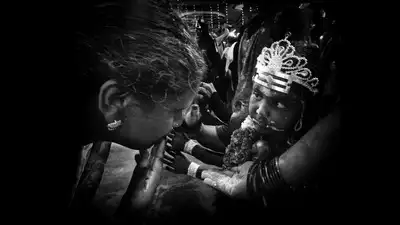
“What began as a chance encounter became an intimate immersion in their lives, beliefs and devotion,” he recalls. “I believe photography takes time: time to observe, time to live in a place, time to let moments unfold naturally, and finally, time to create an image and bring it to life as a print. ” This philosophy informs Roopa, inviting viewers to look beyond the pageantry of Kulasai Dasara and engage with the deeper meanings embedded in its rituals. In India, faith and tradition often blur the boundaries between the human and the divine. At Kulasai Dasara, a folk festival celebrated during the Dasara season in Kulasekarapattinam, Tamil Nadu, devotees dress as gods, goddesses and demons. The festivities culminate in a dramatic beach ritual depicting the goddess slaying a demon. Roopa: Kulasai Dasara, an exhibition of black-and-white photographs by Karthik Samprathi at Alliance Française de Bangalore, offers an intimate glimpse into this extraordinary celebration of faith, ritual and transformation. There, he found himself sharing a seat with Jayaram, a stranger from the local fishing community. Over the following days, Karthik spent time with Jayaram, his family and the wider community, sharing meals, observing festival preparations and rituals, and sometimes sleeping on the beach or in the town’s narrow bylanes. Experiencing the festival through the eyes of its participants, he became increasingly drawn to the process of transformation unfolding around him. He discovered a world in which rituals were not merely performed but deeply lived. A central thread running through the series is the sequence of Vāyu, Agni and Jala — air, fire and water. Karthik sees these elements as metaphors for the festival’s emotional and spiritual arc: air carries the energy and movement of the procession, fire embodies intensity and the destruction of evil, while water brings the experience towards release and dissolution. From darkness to light The festival’s symbolism of good triumphing over evil resonates with Karthik’s own photographic practice. For him, the process of making a photograph is itself an act of transformation. “When I enter the darkroom, I feel like I am conversing with the photograph, working with light, chemistry, paper and time until the image begins to appear. For ‘Roopa’, this transformation from darkness to light became all the more symbolic: the photographs moved from the darkroom to print, and showcased the theme of darkness to light. ” At a time when images are produced and consumed at extraordinary speed, Karthik welcomes the renewed interest in traditional and alternative photographic processes. Yet he is wary of a culture that prioritises instant image-making and consumption over the experience of seeing and observing. In Karthik’s frames, the human body becomes a vessel of faith, while the boundaries between the mortal and the divine begin to dissolve. Download the TOI App.