
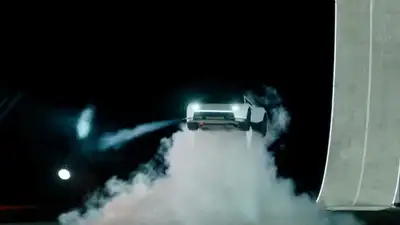
Tesla unveils its long-delayed Roadster nearly a decade after first revealing a next-generation version of its original electric sports car, at a launch event in Texas, US, on October 15, 2026, in this still image taken from a handout video. (Photo credit: Tesla)
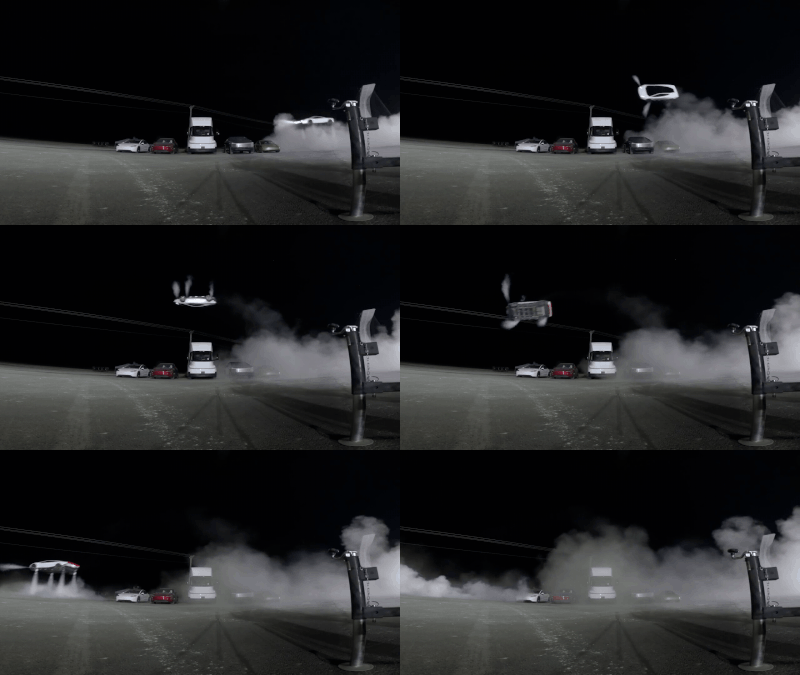
Video credit: X/Elon Musk Tesla unveils its long-delayed Roadster nearly a decade after first revealing a next-generation version of its original electric sports car, at a launch event in Texas, US, on October 15, 2026, in this still image taken from a handout video. (Photo credit: Tesla) Video credit: X/Elon Musk Tesla unveils its long-delayed Roadster nearly a decade after first revealing a next-generation version of its original electric sports car, at a launch event in Texas, US, on October 15, 2026, in this still image taken from a handout video. (Photo credit: Tesla) Tesla has unveiled a redesigned version of its next-generation Roadster electric sports car, featuring built-in thrusters and flying-car-like manoeuvres, nearly nine years after first presenting the prototype. The company said production of the two-seater vehicle would begin in 2028. Musk said the Roadster could accelerate from zero to 60 miles per hour in less than one second and achieve a top speed exceeding 230 mph. Tesla first unveiled a prototype of the second-generation Roadster in 2017, promising deliveries in 2020. The latest announcement pushes the expected production timeline to 2028, extending the wait for the electric sports car by several years. Musk had previously said the four-seat Roadster would offer a range of 620 miles (1,000 km) on a single charge. Goldstein expects Tesla to sell around 2,000 Roadsters annually, a small fraction of the 1.6 million vehicles the company sold last year. From electric sports cars to AI and robotics The original Roadster, launched in 2008 and sold until 2012, was Tesla’s first electric vehicle. Tesla subsequently expanded its lineup with the Model S and Model 3 sedans and the Model X and Model Y SUVs.
The Roadster’s return therefore comes at a time when Tesla is seeking to demonstrate its technological ambitions beyond conventional electric vehicles. The company has also introduced the Cybercab, a two-seat robotaxi designed without conventional manual driving controls.
In 2023, he described the project as a “small potato situation” that would not “move the needle in a major way financially. The Roadster will be Tesla’s new halo car,” Morningstar analyst Seth Goldstein said in a note last month. The Roadster has been developed in collaboration with Elon Musk ‘s rocket company, SpaceX. The legality and practical use of these features on public roads remained unclear. Despite its ambitious performance targets, Musk has played down the vehicle’s potential contribution to Tesla’s finances. However, analysts see the Roadster as an opportunity for Tesla to showcase its engineering capabilities and strengthen its premium brand image. “Tesla does not currently have a halo car, or high-performance luxury vehicle designed to showcase an automaker’s best engineering and technology. Built on a Lotus Elise chassis, it helped challenge perceptions about the performance capabilities of electric cars. The latest Roadster reveal comes as the company increasingly shifts its focus towards artificial intelligence, autonomous driving and robotics, alongside its traditional electric vehicle business. This year, Tesla stopped selling the Model S and Model X to free up production capacity for its Optimus humanoid robots. You use AI every day. Now get your AI Quotient. Take the AIQ test.
The demonstration, held at a SpaceX test site in McGregor, Texas, on Thursday, showed the vehicle driving upside down on a ramp using a suction system, turning in mid-air and landing with the help of built-in thrusters.